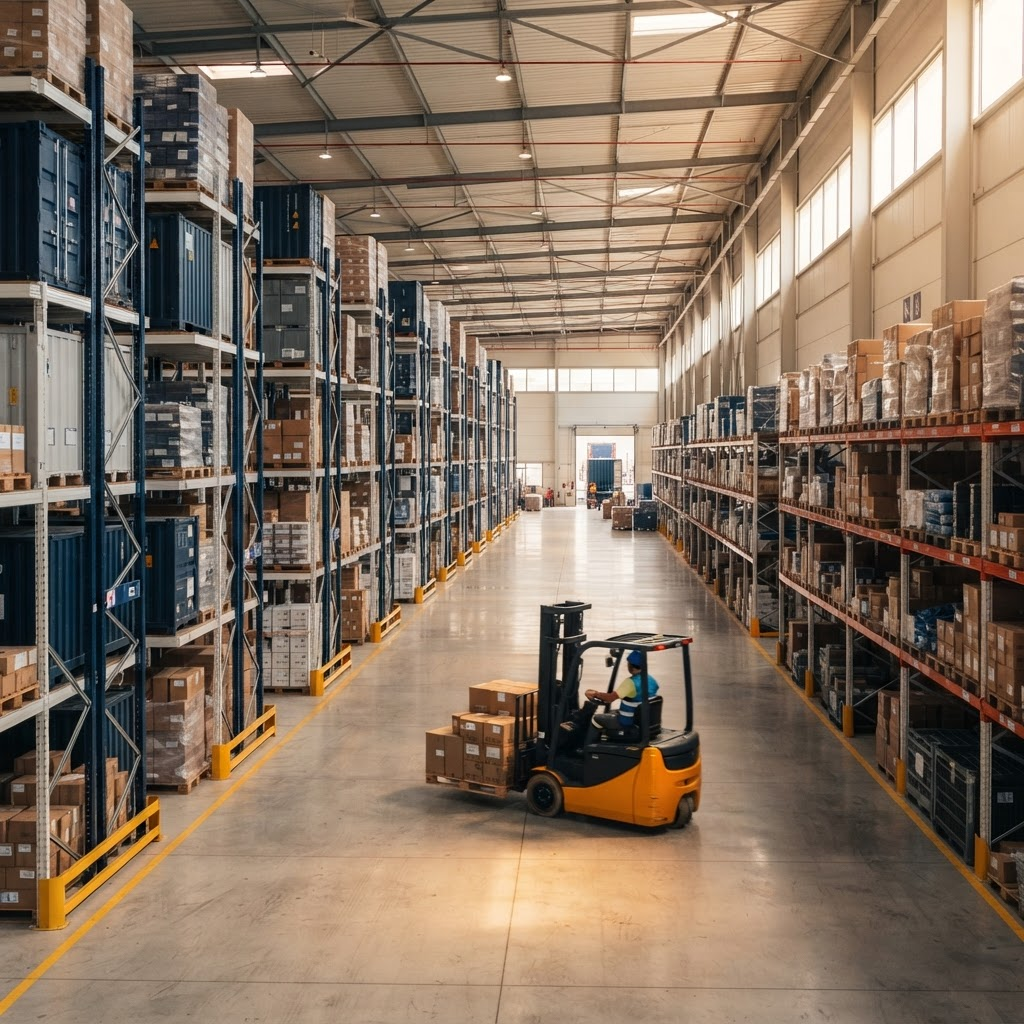
Store it yourself, or hand it to a 3PL?
Any company moving goods through Morocco eventually faces the same question: should we store and fulfil inventory ourselves, or hand that work to a third-party logistics (3PL) provider? The answer depends on volume, how predictable that volume is, and — increasingly — on whether the goods can be stored inside one of Morocco's free zones, where import duties and VAT can be suspended until the goods move into the local market.
This guide breaks down what 3PL warehousing in Morocco includes, how warehousing and fulfillment costs are typically structured, how free-zone and bonded warehouse storage works at logistics hubs like Tanger Med, and a practical framework for deciding between in-house storage and outsourcing to a logistics company in Morocco.
At a Glance
| Section | Focus |
|---|---|
| 1 | What 3PL warehousing actually is |
| 2 | Core 3PL services available in Morocco |
| 3 | How 3PL warehousing costs are structured |
| 4 | Free-zone warehousing and why Morocco's zones matter |
| 5 | Tanger Med's Zone Franche Logistique (Medhub) |
| 6 | In-house warehousing vs. outsourcing to a 3PL |
| 7 | What to look for in a 3PL provider |
| 8 | Common mistakes when choosing warehousing |
1. What Is 3PL Warehousing?
Third-party logistics (3PL) means outsourcing the physical handling of your inventory — storage, order processing, and often the outbound shipment — to a specialized provider instead of leasing and staffing a warehouse yourself. A 3PL provider typically operates the facility, the technology that tracks stock, and the labor, while the client retains ownership of the goods and control over sales and demand planning.
For companies trading with or through Morocco, this usually means goods arrive at a port such as Tanger Med, are received into a 3PL's warehouse, and are then stored, consolidated, or shipped onward — regionally into Morocco, back out to Europe, or further into Africa — without the client needing a legal entity, staff, or leased space of its own in the country.
2. Core 3PL Services Available in Morocco
A 3PL contract in Morocco can cover a wide range of activities depending on the provider and the client's needs:
- Storage & inventory management — physical space plus a warehouse management system (WMS) giving real-time visibility into stock levels and movements.
- Order fulfilment — picking, packing, labelling and preparing outbound shipments for air, ocean, road or courier transport.
- Cross-docking & consolidation — moving goods from inbound to outbound with little or no storage time, or combining several smaller shipments into one larger one to reduce freight cost.
- Value-added services — kitting, re-labelling, re-packaging, and quality control checks before goods reach their destination.
- Temperature-controlled storage — for goods that cannot be held in ambient conditions.
- Security & compliance — round-the-clock surveillance and, inside free-zone facilities, compliance with customs record-keeping requirements.
3. How 3PL Warehousing Costs Are Structured
3PL providers rarely publish a fixed price list, because cost depends heavily on volume, product type and how long goods stay in storage. That said, pricing is almost always built from the same components:
| Cost component | How it is typically charged |
|---|---|
| Storage fees | Per pallet position or per square/cubic meter, billed per day or per month |
| Handling fees | Per inbound or outbound movement (per pallet, carton or order line) |
| Setup / onboarding | One-time fee to configure the WMS, barcoding and custom packaging |
| Value-added services | Per unit or per hour, for kitting, re-labelling, QC or special packaging |
| Minimum commitments | Minimum monthly storage or throughput, common for dedicated space |
The main variables that push the price up or down are volume (higher, steadier volume brings lower per-unit rates), how much handling each order needs (a single-SKU pallet shipment is cheaper to process than multi-item e-commerce orders), seasonality, and how long stock sits before it moves.
Practical point: Because handling fees are billed per movement, high-turnover operations can end up paying more in handling than in storage. Comparing providers on storage rate alone can be misleading — most 3PLs, including Hitek, quote per client rather than publish a fixed rate card.
4. Free-Zone Warehousing: Why Morocco's Zones Matter
What Is a Free Zone (Zone Franche)?
A free zone — sometimes called a bonded warehouse zone — is a designated area, typically attached to a port, where goods can be imported, stored, transformed or re-exported under a special customs regime. Morocco has built several of these free-zone and bonded-warehouse areas around its main ports and industrial corridors, with the Tanger Med Logistics Zone (Medhub) being the largest logistics-focused example.
Duty and VAT Suspension Explained
Inside a free zone, import duties and VAT are generally suspended rather than collected at the moment goods enter the zone. The tax point is deferred until the goods leave the zone into the Moroccan domestic market — at which point standard import duties and VAT apply. Goods that are re-exported from the zone (sent onward to another country without entering the Moroccan market) can avoid Moroccan import duty and VAT altogether.
This is the core reason companies use free-zone warehousing: it lets them hold regional stock close to their customers without paying duty on inventory that hasn't been sold yet, and without paying duty at all on stock that is ultimately re-exported.
Confirm before you commit: Morocco's free zones and its wider Investment Charter also provide for reduced corporate tax treatment for qualifying activities. Eligibility conditions and rates are set by Moroccan law and can be revised — confirm current terms with Morocco's Investment Agency (AMDIE) or a local tax advisor before basing a location decision on tax treatment alone.
Who Benefits Most from Free-Zone Storage
- Importers who re-export a meaningful share of what they bring into Morocco (regional distribution to other African or European markets).
- Companies testing the Moroccan market who don't yet know how much stock will ultimately be sold locally versus re-exported.
- Businesses consolidating shipments from multiple suppliers before onward distribution, where duty should only apply to the portion that enters Morocco.
- Manufacturers needing to hold imported components or finished goods without tying up cash in duty paid on stock that hasn't sold yet.
5. Tanger Med's Zone Franche Logistique (Medhub)
Tanger Med is Morocco's largest port complex and one of the busiest transshipment hubs on the Africa-Europe route, connecting to more than 180 ports across roughly 70 countries. Its logistics free zone, Medhub, sits minutes from the container terminals at Ksar El Majaz and is purpose-built for warehousing, consolidation and distribution operations serving Europe, Morocco and West Africa from a single site.
Operating from Medhub means a company's stock is a short truck ride from vessel arrival, rather than needing to clear customs and move goods inland before storage can begin.
6. In-House Warehousing vs. Outsourcing to a 3PL
Running your own warehouse in Morocco means leasing or building space, hiring and training staff, buying a WMS and handling equipment, and carrying those costs whether volume is high or low that month. Outsourcing to a 3PL converts most of that into a variable cost tied to actual volume — you pay for the pallets stored and orders processed, not for idle capacity. The trade-off is that per-unit 3PL rates are usually higher than the marginal cost of your own high-volume operation once it's running efficiently — the crossover point is a question of scale.
| Choose in-house when… | Choose a 3PL when… |
|---|---|
| Volume is large, stable and predictable enough to keep a dedicated facility utilized | You are entering the market and don't yet know how much volume to expect |
| You already have (or plan to build) a long-term local presence and team | Demand is seasonal or fluctuates, leaving fixed warehouse costs idle part of the year |
| Very specific handling, security or process needs are hard to standardize in a shared facility | You have no local legal entity or staff and don't want to build one just to store stock |
| — | Goods benefit from free-zone duty suspension, which requires a licensed free-zone facility |
7. What to Look for in a 3PL Provider in Morocco
- Free-zone licensing — confirm the facility is licensed to operate inside the free zone if duty suspension is part of the plan.
- System visibility — real-time access to stock levels and order status, not just a monthly report.
- Multimodal connections — the ability to hand off outbound shipments to air, ocean, road or courier transport under one relationship, rather than coordinating separate vendors.
- Transparent pricing — a clear breakdown of storage, handling and value-added fees, so costs are predictable as volume changes.
- Track record with your product type — experience with the right handling requirements, whether that's automotive parts, temperature-sensitive goods, or e-commerce parcels.
8. Common Mistakes When Choosing Warehousing in Morocco
- Assuming free-zone storage automatically means duty-free — duty and VAT are suspended, not cancelled, and become payable once goods enter the domestic market.
- Choosing a facility on storage rate alone — without checking handling fees, which often make up the larger share of the total bill for high-turnover operations.
- Underestimating lead time — setting up a dedicated facility takes far longer than onboarding into an existing shared 3PL warehouse.
- Not confirming onward transport connections — which can leave a company coordinating a separate freight forwarder anyway.
How Hitek Logistic Morocco Supports 3PL Warehousing
Hitek Logistic Morocco operates warehousing and 3PL services from the Tanger Med Zone Franche Logistique (Medhub), minutes from the port terminals. Services include flexible short- and long-term storage, real-time inventory management, order picking and packing, temperature-controlled storage for sensitive goods, and value-added fulfillment services such as kitting, labelling and quality control.
Because the facility operates inside the free zone, Hitek can offer duty-suspended, bonded warehousing — allowing clients to import, consolidate and re-export regionally while goods remain under duty suspension — combined with direct access to Hitek's air freight, ocean freight, road freight and courier services for onward shipment, all under one logistics provider in Morocco.
Conclusion
Warehousing strategy in Morocco isn't only a cost decision — it's also a customs and cash-flow decision. Companies with steady, high-volume flows and established local presence often do best to build their own capacity over time. Companies entering the market, managing seasonal demand, or re-exporting a meaningful share of their goods typically get more value from a 3PL and supply chain partner operating inside a free zone like Tanger Med's Medhub, where duty and VAT stay suspended until goods reach their final market.