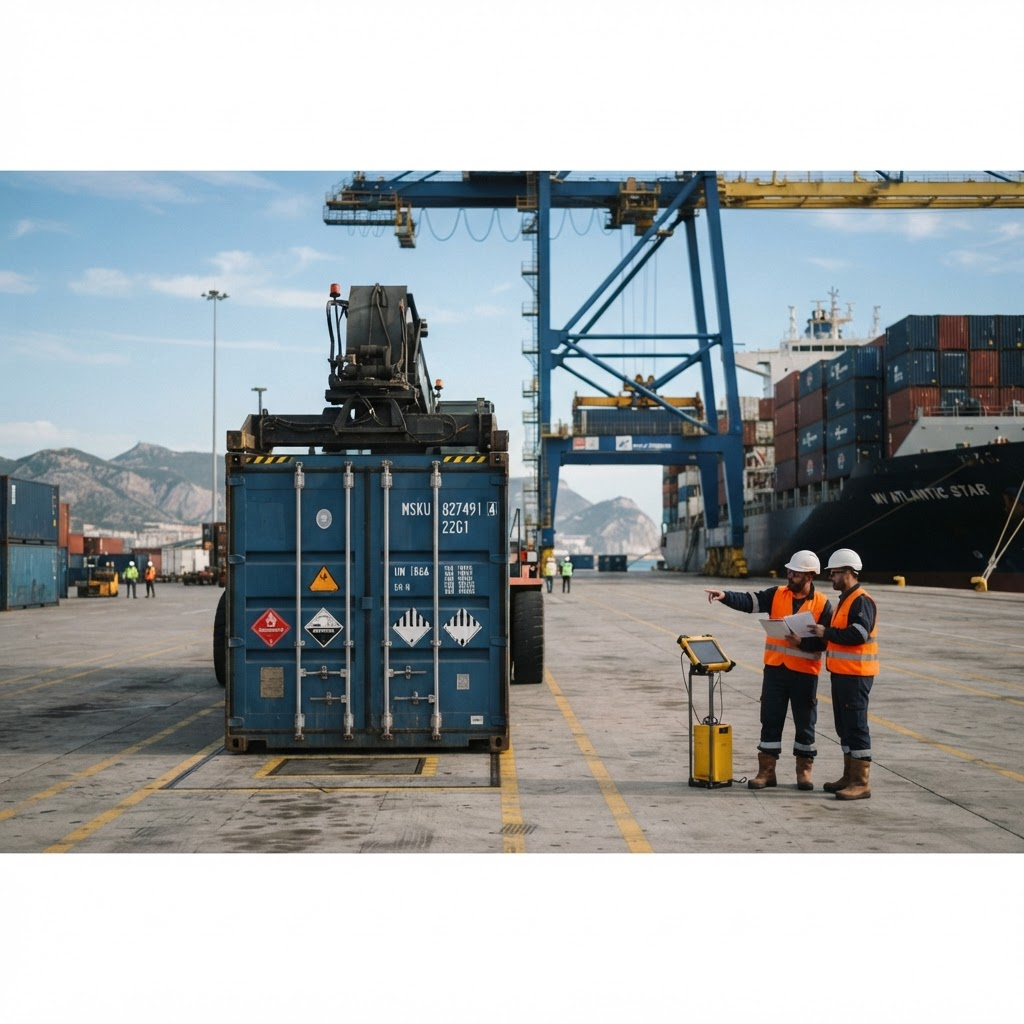
Roughly ten percent of everything shipped by sea is classified as dangerous goods: substances or articles that pose a risk to health, safety, property or the environment during transport, from industrial chemicals and fuels to lithium batteries and pesticides. Moving them safely inside standard shipping containers is governed by a single, unified international rulebook: the IMDG Code.
This article explains what dangerous goods are, how they are classified, how they are labelled, which containers carry them, and why these matters are important for logistics operators, including those working through Moroccan ports such as Tanger Med.
1. What Are Dangerous Goods, and Who Regulates Them?
Dangerous goods, also called hazardous materials or hazmat, are substances and articles that, because of their chemical, physical or biological properties, present a risk during handling or transport. These risks include fire, explosion, poisoning, contamination, corrosion or radiation exposure.
For sea transport, these substances are governed by the International Maritime Dangerous Goods Code (IMDG Code), developed and maintained by the International Maritime Organization (IMO), a specialized agency of the United Nations. The IMDG Code operates under the umbrella of SOLAS, the International Convention for the Safety of Life at Sea, and is recognized and applied by virtually every maritime nation, including Morocco.
The IMDG Code is revised every two years to keep pace with new products, such as new battery chemistries, and lessons learned from incidents at sea. It standardizes classification, packaging, labelling, documentation, stowage and segregation so that a container loaded with hazardous cargo in one country is handled consistently and safely at every port and on every vessel it passes through.
2. The Nine Classes of Dangerous Goods
The IMDG Code organizes all dangerous goods into nine hazard classes, several of which are further split into divisions. Every class has its own diamond-shaped hazard label, color code and stowage rules so that dockworkers, ship crews and emergency responders can identify a hazard quickly without reading the shipping documents.
| Class | Name | Description and examples |
|---|---|---|
| 1 | Explosives | Substances or articles with a mass explosion, projection, fire or minor blast hazard, such as fireworks, ammunition and blasting agents. |
| 2 | Gases | Compressed, liquefied, refrigerated liquefied or dissolved gases; flammable, non-flammable/non-toxic, or toxic, such as propane, oxygen and chlorine. |
| 3 | Flammable Liquids | Liquids that give off flammable vapors below 60°C, such as petrol, acetone, paints and ethanol. |
| 4 | Flammable Solids | Divided into 4.1 flammable solids, 4.2 substances liable to spontaneous combustion, and 4.3 substances that emit flammable gases when wet, such as matches, sodium and calcium carbide. |
| 5 | Oxidizing Substances and Organic Peroxides | Division 5.1 covers oxidizers that increase fire risk; 5.2 covers thermally unstable organic peroxides, such as ammonium nitrate and hydrogen peroxide. |
| 6 | Toxic and Infectious Substances | Division 6.1 covers substances liable to cause death or serious injury if inhaled, ingested or absorbed; 6.2 covers infectious substances containing pathogens, such as pesticides and clinical waste. |
| 7 | Radioactive Material | Material containing radionuclides where activity and concentration exceed defined values, such as medical isotopes and uranium. |
| 8 | Corrosive Substances | Substances that cause full-thickness destruction of skin or severely corrode metal, such as sulphuric acid and sodium hydroxide. |
| 9 | Miscellaneous Dangerous Substances | Substances presenting a danger not covered by the other classes, such as lithium batteries, dry ice, asbestos and environmentally hazardous substances. |
Some substances present more than one hazard. For example, a flammable liquid may also be toxic. In these cases, both a primary hazard class and one or more subsidiary risks are declared, and the more restrictive stowage and segregation rules apply.
3. Marking, Labelling and Documentation
Every package and container carrying dangerous goods must display the correct diamond hazard label for its class, along with its UN number, a four-digit code that identifies the exact substance. Examples include UN 1203 for petrol and UN 1993 for a flammable liquid not otherwise specified.
Cargo is also assigned a Packing Group—I, II or III—reflecting the degree of danger, from great danger to minor danger.
The shipper must issue a signed Dangerous Goods Declaration describing:
- The technical name of the substance
- Its hazard class
- Its UN number
- Its packing group
- Emergency contact information
This document must accompany the shipment at every stage, from the factory gate through the freight forwarder and port terminal to the final consignee. Incomplete or inaccurate declarations are one of the leading causes of dangerous goods incidents at sea. This is why terminals and carriers increasingly cross-check declarations electronically before a container is accepted for loading.
4. Which Containers Are Used for Dangerous Goods?
Most dangerous goods that are solids or packaged liquids travel in ordinary steel general-purpose or ventilated containers, provided the packaging itself—drums, jerricans, IBCs or boxes—meets UN performance-testing standards for that hazard class and packing group. The container itself does not need to be hazmat-specific in these cases; what matters is that the packaging inside it is certified and correctly labelled.
Bulk liquids, liquefied gases and many corrosive or toxic chemicals instead travel in specialized tank containers. These are built and pressure-tested to strict international standards, such as the IMO tank types and the T-codes referenced in the IMDG Code. They are fitted with valves, pressure-relief devices and, depending on the product, insulation or heating coils.
Certain classes require dedicated, purpose-built equipment and additional certification:
- Explosives (Class 1) generally require specially approved containers and strict quantity limits per container.
- Radioactive material (Class 7) requires shielded, certified packages and often exclusive-use containers with restricted stowage positions.
- Some flammable or toxic gases (Class 2) require certified pressure vessels with continuous monitoring during transport.
5. Stowage, Segregation and Ship Planning
Different hazard classes can react dangerously if they come into contact—for example, an oxidizer stowed next to a flammable liquid or an acid next to a cyanide compound. The IMDG Code therefore sets out detailed segregation tables that dictate minimum distances or separation by a complete compartment between incompatible classes aboard a vessel.
Terminal operators and ship planners use specialized software that cross-references every dangerous goods container's class, UN number and packing group before it is loaded onto a ship. Some classes—radioactive material, certain explosives and some highly toxic substances—are restricted to designated deck positions away from crew accommodation, engine spaces and other high-risk zones.
Some ports also impose additional local restrictions or require advance notification before a dangerous goods container can enter the terminal.
6. Why This Matters for Ports Like Tanger Med
Morocco's position on the Strait of Gibraltar and the scale of the Tanger Med port complex mean that a significant volume of the containers passing through Moroccan terminals each year includes dangerous goods. These include chemicals, fuels, industrial gases, batteries and agricultural inputs.
As an IMO member state and SOLAS signatory, Morocco applies the same IMDG Code requirements described in this article at its ports; there is no separate national dangerous-goods classification system layered on top of it.
For freight forwarders, exporters and logistics companies operating in this market, understanding IMDG classification is not academic. Choosing the wrong container type, mislabelling a hazard class, omitting a UN number or overlooking a segregation requirement can lead to:
- Shipment refusals
- Regulatory penalties
- Demurrage costs
- Safety incidents at the terminal
Getting the classification and documentation right the first time is one of the simplest ways to keep a dangerous goods shipment moving without delay.
7. Conclusion
Dangerous goods transport by sea works because the entire industry—shippers, packers, freight forwarders, terminal operators and ship crews—follows the same internationally agreed rulebook: the IMDG Code.
Its nine hazard classes, standardized labelling, UN numbering and segregation rules exist because of decades of accumulated safety experience. They apply identically whether a container is loaded in Rotterdam, Shanghai or Tanger Med.
For a broader look at container types and how ocean-freight shipments are planned and priced, read our guide to ocean freight, container types and LCL chargeable weight.