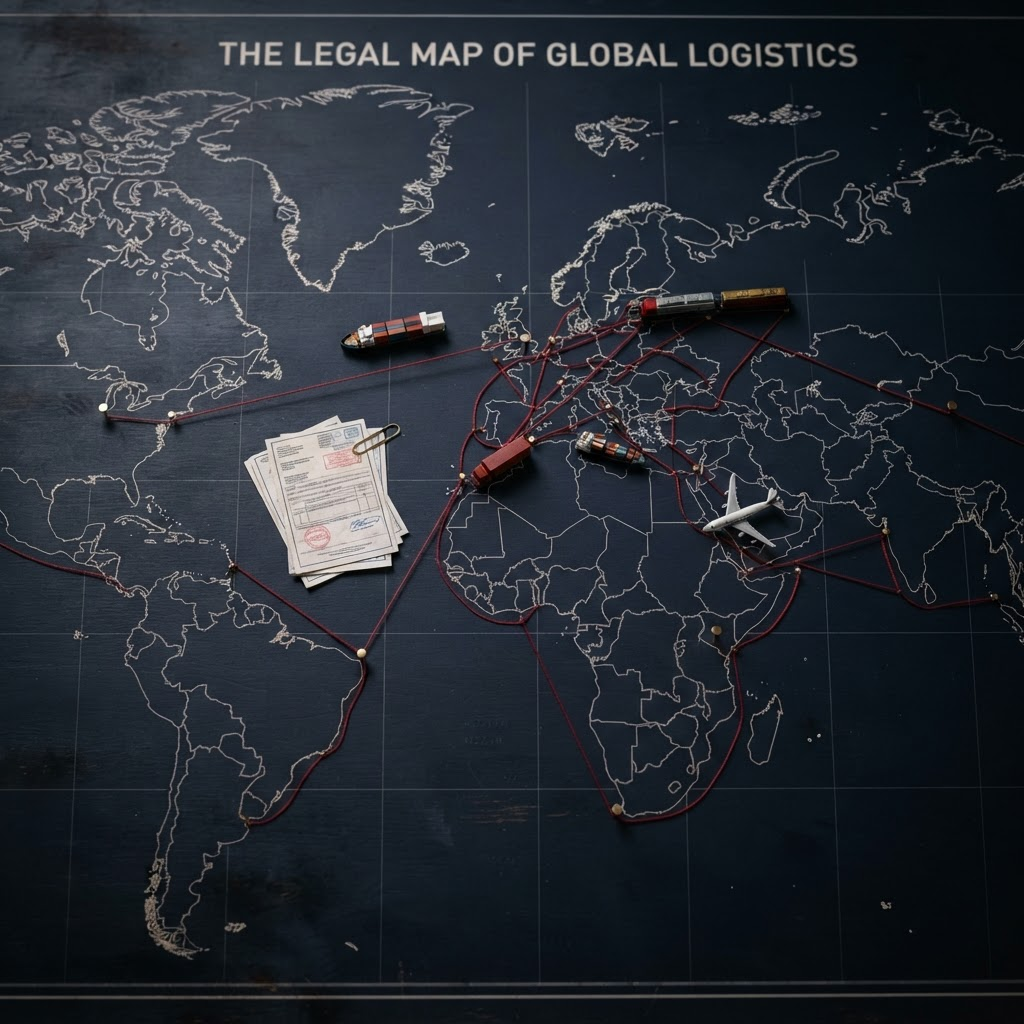
A shipment does not move through geography alone. It also moves through legal systems.
A shipment leaving a factory in Morocco may be governed by one international regime when it travels by truck to France, another when it flies to Canada, and a more fragmented set of rules when it is loaded into a container for an overseas port. If road, sea, and rail are combined under one logistics operation, the answer becomes more complex still.
When everything arrives correctly, these systems remain almost invisible. When high-value cargo disappears, machinery arrives damaged, or production material is delivered late, the questions become immediate:
- Who is legally responsible?
- How much can be recovered?
- Which transport document matters?
- How quickly must a claim be made?
- Does cargo value determine compensation?
- Does the Incoterm decide liability?
- What happens when several transport modes are involved?
There is no single convention governing every international freight movement. The legal map is organized largely around the mode of transportation: CMR for road, Montreal 1999 for air, CIM/COTIF for rail, and several competing frameworks for sea freight.
Important legal note: This article provides general educational information and is not legal advice. The applicable rules depend on the contract, countries, transport documents, treaty status, national law, and facts of each shipment.
At a Glance
| Section | Focus |
|---|---|
| 1 | No single "international freight law" |
| 2 | Road freight: the CMR Convention |
| 3 | Road carrier liability and weight-based limits |
| 4 | Claims deadlines and e-CMR |
| 5 | Air freight: the Montreal Convention 1999 |
| 6 | Sea freight: Hamburg, Hague-Visby, and national law |
| 7 | Rotterdam Rules: modern ambition, not yet in force |
| 8 | Rail freight: CIM / COTIF |
| 9 | Multimodal shipments and overlapping regimes |
| 10 | Incoterms, TIR, insurance, and dangerous goods |
| 11 | Claims response and digital evidence |
| 12 | What this means for Moroccan importers and exporters |
1. There Is No Single "International Freight Law"
It is tempting to think that international cargo is governed by one international transport law. In practice, the first question is much more direct: How is the cargo being transported?
| Transport mode | Principal international framework |
|---|---|
| International road freight | CMR Convention |
| International air freight | Montreal Convention 1999 |
| International rail freight | CIM / COTIF |
| International sea freight | Hague/Hague-Visby, Hamburg Rules, and national law |
| Sea + inland door-to-door | Potentially multiple regimes |
| Customs transit | Separate systems such as TIR may apply |
| Dangerous goods | Additional modal safety regulations apply |
Even this table is only a starting point. Whether a convention applies can depend on the countries involved, the contractual route, place of taking over, place of delivery, transport document, carrier’s role, location of damage, national law, and treaty ratification status.
Practical point: Two shipments that look operationally similar can produce different legal outcomes because their treaty status, contractual structure, or location of damage differs.
2. Road Freight: The CMR Convention
For companies trading between Morocco and Europe, CMR is probably the most familiar transport convention. Its full name is the Convention on the Contract for the International Carriage of Goods by Road. It was signed in Geneva in 1956, entered into force in 1961, and Morocco acceded to it in 1995.
CMR broadly applies to contracts for the carriage of goods by road for reward when the place where the goods are taken over and the designated place of delivery are in two different countries and at least one is a contracting country.
Commercial movements such as Tangier–Madrid, Kenitra–Paris, or Casablanca–Frankfurt can therefore fall within the CMR framework when the Convention’s conditions are met.
The CMR Convention Is More Than the CMR Document
People often ask, "Do we have the CMR?" when they mean the road consignment note. The Convention and the consignment note are not the same thing.
The Convention establishes legal rules for the contract of carriage and carrier liability. The consignment note records shipment information such as sender, consignee, carrier, collection point, destination, goods, weight, packages, instructions, and reservations.
The document is important evidence, but the legal framework is wider than the paper itself.
3. What Is a Road Carrier Actually Liable For?
Under CMR, the carrier can be liable for loss or damage occurring between taking over the goods and delivery, as well as for certain delays, subject to the Convention’s rules, exclusions, and defenses.
A common surprise: Carrier liability and cargo value are not necessarily the same. A €200,000 shipment does not automatically create €200,000 of carrier liability.
Under the 1978 Protocol to CMR, the loss limitation was converted to 8.33 Special Drawing Rights (SDR) per kilogram of gross weight short. Not every country party to the original Convention is necessarily party to each subsequent protocol, so the treaty version applicable to the actual shipment must be confirmed.
Why Weight-Based Liability Matters
| Shipment | Gross weight | Commercial value | Why the distinction matters |
|---|---|---|---|
| Basic raw material | 1,000 kg | €2,000 | Commercial value may be low relative to weight. |
| High-value electronics | 1,000 kg | €200,000 | Same weight, radically different financial exposure. |
A convention-based limitation may be calculated mainly by weight rather than the commercial value of the goods. This is one reason carrier liability insurance and cargo insurance are not interchangeable.
4. Claims Deadlines and the Rise of e-CMR
CMR Claims Have Time Limits
Under Article 32, claims arising from carriage governed by CMR generally become time-barred after one year. A three-year period applies in certain cases involving wilful misconduct or equivalent fault under the applicable law.
That does not mean a logistics team should wait. A practical claims file should begin immediately with photographs, delivery reservations, transport documents, packing list, commercial invoice, survey evidence where appropriate, correspondence, proof of value, and evidence of the cargo’s condition.
Claims principle: Documentation becomes part of the evidence chain. Preserve it before the dispute begins.
Road Transport Is Becoming Digital
An Additional Protocol adopted in 2008 allows participating countries to recognize an electronic CMR consignment note, or e-CMR. The Protocol entered into force in 2011, and additional states continued joining during 2026.
International road transport is gradually moving from paper documents toward structured digital data. That matters for proof of delivery, claims management, tracking, and customs integration.
5. Air Freight: The Montreal Convention 1999
Put the same cargo on an aircraft and the legal map changes. The principal modern international framework is the Convention for the Unification of Certain Rules for International Carriage by Air, better known as the Montreal Convention 1999 or MC99.
It entered into force in 2003 and modernized the earlier Warsaw system. Morocco became a party in 2010.
Air Cargo Liability: 26 SDR per Kilogram
The current liability limit for destruction, loss, damage, or delay involving cargo is 26 SDR per kilogram, following ICAO’s adjustment effective 28 December 2024.
Example: A 100 kg electronics shipment worth €100,000 can have a treaty liability ceiling dramatically below its invoice value unless another applicable mechanism changes the position.
Air Cargo Claims Move Fast
For cargo damage, a written complaint generally must be made no later than 14 days after receipt. For delay, the deadline is generally 21 days from the date the cargo was placed at the recipient’s disposal. Proceedings are subject to a two-year limitation period under Article 35.
For a logistics department, the practical rule is simple: do not leave an air-cargo claim sitting in an inbox.
6. Sea Freight: Where the Legal Map Becomes More Complicated
Road freight has CMR. Air freight has Montreal 1999. Ocean freight is less uniform.
Depending on the countries, shipment, and applicable law, carriage by sea may fall under regimes derived from the Hague Rules, Hague-Visby Rules, Hamburg Rules, national maritime law, and contractual provisions incorporated into bills of lading, subject to mandatory law.
The Hamburg Rules and Morocco
The United Nations Convention on the Carriage of Goods by Sea 1978, commonly known as the Hamburg Rules, entered into force internationally in 1992. Morocco is a contracting state.
Under the Hamburg Rules, liability for loss or damage is generally limited to the higher of:
- 835 SDR per package or other shipping unit, or
- 2.5 SDR per kilogram of gross weight
The "whichever is higher" approach matters because sea freight can range from tonnes of inexpensive commodities to a small package containing high-value equipment.
Why the Bill of Lading Description Matters
Imagine a container carrying 200 cartons while the bill of lading describes only "1 container." Depending on the applicable regime and wording, how packages are enumerated can affect liability-limit calculations.
Documentation principle: Transport documents are not administrative decoration. Cargo descriptions can have legal consequences.
Hague-Visby Remains Important
A global shipper cannot assume Hamburg applies to every ocean shipment. Many major maritime jurisdictions use regimes derived from Hague or Hague-Visby.
Under the Hague-Visby system as amended by the 1979 SDR Protocol, the often-cited limits are 666.67 SDR per package or unit, or 2 SDR per kilogram, whichever is higher. The relevant port, bill of lading, governing law, and treaty status can materially change the analysis.
7. The Rotterdam Rules: Modern Ambition, Not Yet a Global Rule
Modern container transport often combines factory pickup, truck, port, vessel, rail, and final distribution while one logistics provider sells the entire movement under a single contract.
The Rotterdam Rules were developed to modernize contracts involving international carriage wholly or partly by sea, including door-to-door transport, containerization, and electronic transport records.
Critical distinction: As of August 2026, the Rotterdam Rules are not in force. They have only five parties and require twenty actions before entry into force.
CMR and Montreal are established operational conventions. Rotterdam remains an important but not-yet-operative attempt at wider harmonization.
8. Rail Freight: CIM / COTIF
Across much of Europe and connected regions, international rail carriage operates under COTIF, the Convention concerning International Carriage by Rail. The cargo rules are known as the CIM Uniform Rules.
Morocco is a member of COTIF and applies CIM. The consignment note again has an important evidentiary role, and the loss-liability ceiling is 17 SDR per kilogram of gross mass short, subject to the Uniform Rules.
| Mode | Key framework | Illustrative liability concept |
|---|---|---|
| Road | CMR | Weight-based limitation; treaty and protocol status matter |
| Air | Montreal Convention 1999 | 26 SDR/kg for cargo under the current ICAO limit |
| Sea | Hamburg / Hague-Visby / other law | Package and/or weight limits vary by regime |
| Rail | CIM / COTIF | 17 SDR/kg for loss under CIM |
9. When One Shipment Uses Several Transport Modes
Consider this movement:
Casablanca factory → Truck to Tanger Med → Container vessel to Rotterdam → Rail to Germany → Final truck delivery
Commercially, the customer sees one shipment. Operationally, it has several stages. Legally, the picture may be more complex.
If the container arrives damaged, where did the damage occur—on the Moroccan truck, at the terminal, during sea transport, on rail, or during final delivery? If the stage can be identified, a particular modal regime may become relevant. If it cannot, the multimodal contract’s liability provisions and applicable law become especially important.
Multimodal principle: A single commercial booking does not necessarily mean a single underlying legal regime.
Freight Forwarder or Carrier?
"Freight forwarder" describes a business activity; it does not answer every legal question. A forwarder can act mainly as an intermediary in one transaction and contract as carrier toward the customer in another.
House and Master Bills of Lading, Air Waybills, CMR notes, forwarding conditions, and service contracts help establish who contracted to do what. For high-value freight, ask not only "Who booked my freight?"" but "Who is my contractual carrier?"
10. Incoterms, TIR, Dangerous Goods, and Insurance
Incoterms Do Not Determine Carrier Liability
Incoterms such as EXW, FCA, CPT, CIP, DAP, and DDP primarily allocate responsibilities, costs, and risk between seller and buyer. They do not replace transport conventions.
| Relationship | What it primarily governs |
|---|---|
| Seller / Buyer | Delivery obligations, allocation of costs, and transfer of risk under the Incoterm |
| Cargo interest / Carrier | Transport contract and carrier liability under the applicable convention and law |
A DAP sale may require the seller to arrange transport, but if the road carrier damages the goods, the carrier relationship can still be governed by CMR.
TIR Is Not Carrier-Liability Law
TIR establishes an international customs-transit system for qualifying goods moving through participating territories using secure vehicles or containers and an international guarantee mechanism. It facilitates customs transit; it does not replace CMR.
The same Morocco–Europe shipment can involve CMR for carriage and TIR for customs transit—different systems serving different purposes.
Dangerous Goods Add Another Layer
Lithium batteries, chemicals, gases, flammable liquids, and other regulated materials bring requirements for classification, packaging, labelling, documentation, segregation, equipment, acceptance, and training.
A single shipment can therefore be influenced by transport contract law, customs law, dangerous-goods regulation, trade controls, and insurance requirements at the same time.
Carrier Liability and Cargo Insurance Are Different
| Carrier liability | Cargo insurance |
|---|---|
| Protects the carrier against legal liabilities within the applicable framework. | Protects the financial interest in the goods according to the policy’s coverage, limits, and exclusions. |
Risk-management lesson: Never assume that "the carrier has insurance" means the full invoice value is insured.
11. Why SDR Appears Everywhere
CMR, Montreal, Hamburg, and CIM all refer to the Special Drawing Right (SDR). International treaties need a liability unit that works across currencies. The SDR is an internationally recognized accounting unit maintained by the International Monetary Fund and based on a basket of major currencies.
When a convention says "26 SDR/kg", that is not a fixed euro amount. The SDR value must be converted into the applicable currency at the relevant time under the governing rules.
12. The Legal Map in One Table
| Shipment | Main legal framework to investigate |
|---|---|
| Truck Morocco → France or Spain | CMR |
| Air freight Morocco → Canada or France | Montreal Convention 1999 |
| Sea shipment to/from a Hamburg Rules country | Hamburg Rules may apply |
| Sea shipment involving a Hague-Visby jurisdiction | Hague-Visby may apply |
| International rail shipment under COTIF | CIM |
| Road customs transit | TIR may additionally apply |
| Dangerous-goods shipment | Modal dangerous-goods rules additionally apply |
| Sea + truck + rail door-to-door | Potential multimodal / network analysis |
| Shipment claimed under Rotterdam Rules | Check carefully: Convention is not yet in force |
The phrase "to investigate" is intentional. A table can guide the first question; it cannot replace legal analysis of a disputed claim.
13. What to Do When Cargo Arrives Damaged
- Inspect the cargo: Check packaging and goods before signing a clean delivery receipt whenever possible.
- Record clear reservations: Write factual, specific reservations on the delivery or transport document.
- Take photographs: Document packaging, seals, pallets, container, cargo, labels, and vehicle where relevant.
- Preserve packaging: It may become important evidence when determining how damage occurred.
- Notify the contractual logistics party: Do not assume telling the driver verbally is sufficient.
- Check the notice deadline: Different conventions impose different procedural requirements.
- Preserve commercial evidence: Keep invoices, purchase orders, transport documents, packing lists, serial numbers, repair estimates, and survey reports.
- Notify the cargo insurer: If coverage applies, comply with policy requirements immediately.
Claims principle: A well-managed claim begins with preserving evidence, not arguing about who is responsible.
14. Digital Logistics Is Changing the Evidence
Transport documents are becoming electronic. e-CMR is expanding, electronic air waybills are established, and electronic bills of lading are gaining adoption. Tracking platforms record location, timestamps, temperature, door openings, delivery events, routing, and exceptions.
A cargo dispute once based on "the driver says the trailer arrived at 14:00" may now contain GPS timestamps, door-open events, temperature excursions, and delivery scans.
The law may be old. The evidence is becoming real-time.
15. What This Means for Moroccan Importers and Exporters
Morocco participates in several major transport-law systems: CMR for international road transport, Montreal 1999 for qualifying international air carriage, Hamburg for carriage of goods by sea, and COTIF/CIM for international rail transport.
| Example movement | Legal framework to examine first |
|---|---|
| Tangier → Stuttgart by truck | CMR |
| Casablanca → Montreal by air | Montreal Convention 1999 |
| Tanger Med → overseas port by container | Applicable maritime convention / national law |
| Door-to-door multimodal shipment | Contract + potential combination of modal regimes |
Different shipments leaving the same Moroccan factory can therefore operate within different liability systems. Logistics management increasingly requires more than understanding freight rates and transit times; businesses also need a working understanding of the legal architecture behind the movement.
16. How Hitek Approaches International Logistics
At Hitek Logistic Morocco, international freight can involve road transportation, air freight, ocean freight, courier services, warehousing, customs coordination, cross-docking, project cargo, and multimodal transportation.
Before cargo moves, customers should seek clarity on:
- The transport mode and route
- The documents that will be issued
- The identity of the contractual carrier
- Whether cargo insurance is required
- The declared value
- Dangerous-goods requirements
- Multiple transport legs
- The process if cargo is damaged
A well-designed logistics operation is not only about getting freight from origin to destination. It is also about understanding the risks attached to the journey.
Conclusion
International logistics has a physical map of ports, airports, highways, railways, warehouses, and borders. Behind that visible network lies another map:
- CMR for international road transport
- Montreal for international air cargo
- Hamburg and Hague-Visby systems for maritime transport
- CIM for international rail
- TIR for customs transit
- Dangerous-goods rules layered across every mode
- The Rotterdam Rules in the background as an attempt to modernize door-to-door maritime logistics
For most shipments, these conventions remain invisible. That changes the moment cargo disappears, arrives damaged, misses a critical deadline, or becomes involved in a multimodal dispute.
Know the legal route as well as the physical route. Before moving high-value, sensitive, or business-critical cargo, understand the transport structure, applicable documents, contractual carrier, insurance position, and liability framework.
Planning an international or multimodal shipment? Contact Hitek Logistic Morocco to discuss the transport structure, documents, and cargo-risk considerations before your freight moves.