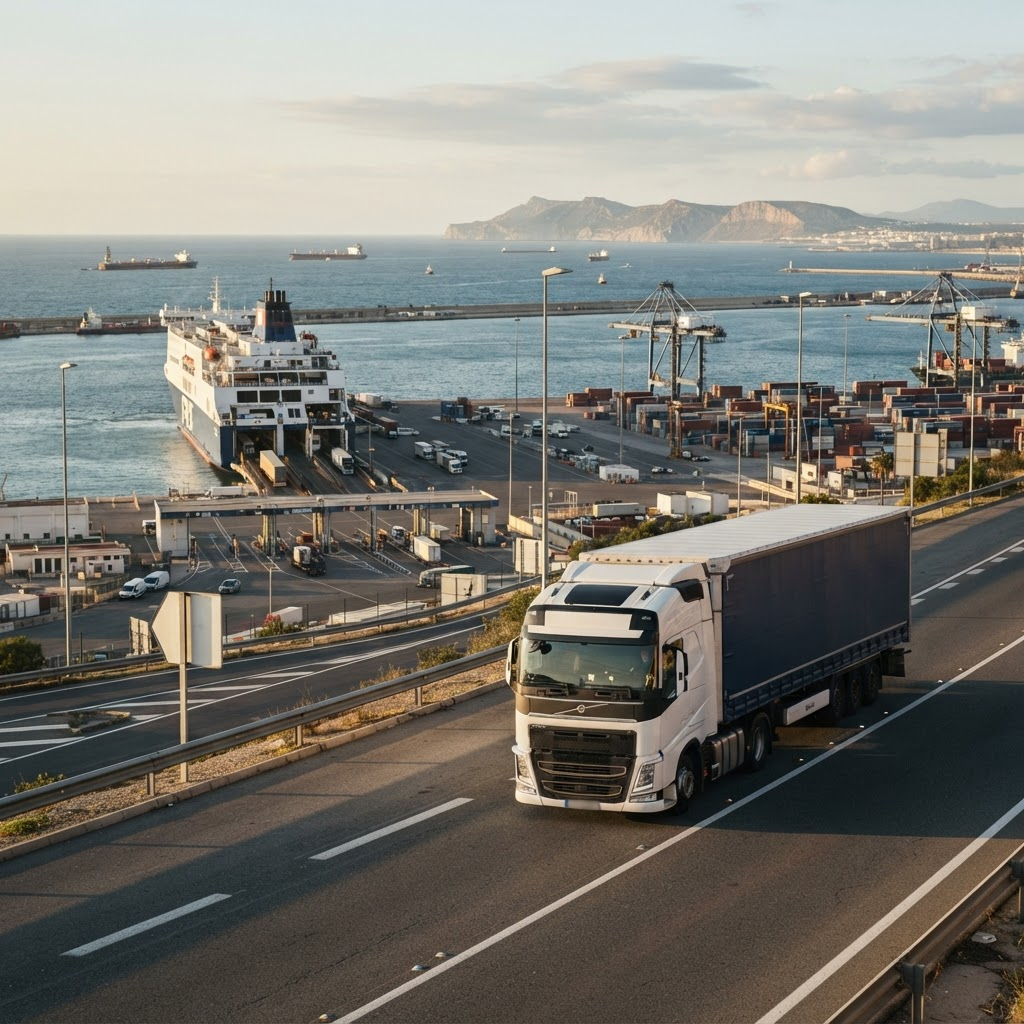
A truck leaving a factory in Morocco for a customer in France, Spain or Germany does not simply drive north.
It reaches Tanger Med, enters a port operation, crosses the Strait of Gibraltar by Ro-Ro ferry, clears the necessary border and customs formalities, enters the European road network and continues toward its final destination.
On a map, Morocco and Europe are separated by only a narrow stretch of water. Operationally, however, that short crossing connects two customs territories, several transport systems and some of the most important industrial supply chains linking Africa and Europe.
In 2025 alone, 535,203 international freight trucks passed through the Tanger Med Port Complex, an increase of 3.6% over 2024. Industrial exports were one of the principal drivers of that growth.
For manufacturers, importers and exporters, the question is therefore no longer simply: "Can we move goods between Morocco and Europe by truck?" The more important questions are whether the shipment should move FTL or LTL, how long the journey should realistically take, what happens at Tanger Med and Algeciras, which documents must travel with the shipment, how customs and rules of origin affect the movement, what causes trucks to lose time, and how the entire operation can be planned as one supply chain instead of several disconnected transport steps.
This guide explains how Morocco–Europe road freight works in 2026.
Article Summary — Quick Read
Road freight between Morocco and Europe normally combines road transport + Ro-Ro ferry + road transport. The most important corridor is Tanger Med–Algeciras. One current freight operator schedules the maritime crossing at approximately 1 hour 30 minutes, although the complete port operation takes longer once check-in, customs, boarding, waiting time and discharge are included.
FTL is generally preferable for large, urgent or production-critical shipments, while LTL allows smaller consignments to share trailer capacity. Transit time depends on much more than distance: ferry schedules, customs status, driver-rest regulations, loading readiness, documentation, inspections, traffic and delivery appointments can all influence the actual ETA.
Commercial invoices, packing lists, the CMR consignment note and applicable customs documentation should all describe the same shipment consistently. Preferential customs treatment between Morocco and the European Union may be available for qualifying originating goods, but simply shipping a product from Morocco does not automatically give it Moroccan preferential origin — the applicable rules of origin and proof requirements must be satisfied.
Practical point: The best road-freight operation is not necessarily the truck with the lowest quoted rate. It is the solution that controls the entire movement from pickup to final delivery.
At a Glance
| Question | Practical Answer |
|---|---|
| Main Morocco–Europe road corridor | Tanger Med–Algeciras |
| How does the truck cross to Europe? | Ro-Ro / Ro-Pax ferry |
| Main transport options | FTL and LTL |
| Best for urgent or production-critical freight | Usually FTL |
| Best for smaller shipments | Usually LTL |
| Main road transport document | CMR consignment note |
| Customs gateway in Morocco | Moroccan customs procedures, including processes integrated through PortNet |
| Preferential origin | May apply when the applicable EU–Morocco origin rules are satisfied |
| Main causes of delay | Documentation, customs, inspections, ferry timing, consolidation, driver hours and delivery appointments |
| Hitek services | FTL, LTL, specialised equipment, cross-border transport, tracking and integrated logistics |
1. Why Morocco–Europe Road Freight Matters
Morocco's logistics geography is unusual. It is located in Africa but sits only a short maritime crossing from the European road network. This makes international trucking particularly relevant for manufacturers whose supply chains cannot always accept the transit time of traditional ocean freight or the cost of air freight.
Tanger Med sits at the centre of this connection. The port's four container terminals handled more than 11.1 million TEUs in 2025, while international truck traffic reached 535,203 units. The truck figure is particularly important because it represents physical supply chains moving between factories, suppliers, distribution centres and customers.
Typical cargo moving between Morocco and Europe includes automotive components, industrial parts, textiles and garments, electronics, aerospace components, agri-food products, retail merchandise, machinery, packaging materials, spare parts, temperature-sensitive cargo and production-critical materials.
For many of these industries, logistics is not simply about getting the cargo there eventually. The cargo has to arrive when production needs it. That changes the way transport should be planned.
2. How Does a Truck Actually Travel from Morocco to Europe?
"Road freight from Morocco to Europe" is slightly misleading because part of the journey takes place at sea. Consider a shipment from Tangier to Paris. A simplified operation may look like this:
Factory in Morocco → Truck collection → Tanger Med → Export and port formalities → Ro-Ro ferry → Algeciras → European entry procedures → Spain → France → Final customer.
The trailer can therefore remain part of a continuous road-transport operation even though it crosses the Strait by ferry. Current freight services on the Algeciras–Tanger Med corridor publish a sailing time of approximately 1 hour 30 minutes, with several freight departures available during the day.
But this is where an important distinction must be made.
Ferry Time Is Not Port Transit Time
A 1.5-hour sailing does not mean the truck spends only 1.5 hours between Morocco and Spain. The total crossing process can also include port arrival, check-in, document verification, customs procedures, security controls, waiting for the booked departure, trailer staging, loading, the maritime crossing itself, discharge, entry procedures and release from the port.
Why this matters: This is why experienced logistics planning focuses on the door-to-door ETA, not simply the sailing duration.
3. FTL vs LTL: Which One Should You Use?
The first major commercial decision is whether the shipment should move as Full Truckload (FTL) or Less Than Truckload (LTL).
FTL — Full Truckload
With FTL, the vehicle or trailer is dedicated to one shipper's cargo. FTL is particularly suitable when the shipment occupies most of a trailer, delivery is urgent, cargo is valuable or sensitive, production depends on the shipment, additional handling should be minimised, loading or delivery schedules are strict, or the shipper wants dedicated capacity.
The main advantage is not simply space. It is control. The truck does not have to wait for other customers' freight to complete a consolidation plan, and the cargo normally undergoes fewer handling steps.
LTL — Less Than Truckload
With LTL, cargo from several customers shares trailer capacity. This makes LTL attractive for a few pallets, smaller regular orders, non-urgent replenishment, samples or commercial stock, and businesses that cannot economically justify a complete trailer. The shipper pays for a portion of the transport capacity rather than an entire vehicle.
The trade-off is that LTL generally requires more coordination. Cargo may need to move through a consolidation point, wait for other freight, be handled additional times or follow a scheduled groupage departure.
FTL vs LTL in Practice
Imagine a supplier in Tangier shipping four pallets to Lyon. Hiring an entire international trailer may leave most of the capacity unused, so LTL may make more financial sense. Now imagine the same supplier needs to send 24 pallets of production material to a French automotive facility where the assembly line depends on delivery. The calculation changes: even if FTL costs more in absolute terms, the value of speed, dedicated capacity and lower handling risk may justify it.
Practical point: The cheapest transport option and the cheapest supply-chain option are not always the same.
4. How Long Does Road Freight from Morocco to Europe Take?
This is one of the most common questions — and one of the easiest to answer badly. Transit time cannot be calculated simply by dividing kilometres by truck speed.
Professional drivers operating within the EU are subject to regulated driving and resting periods. Under EU rules, the standard daily driving period is limited to nine hours, with a permitted extension to ten hours twice during a week. The route must also account for the maritime crossing, port operations, customs and final delivery conditions.
Indicative FTL Planning Windows
For standard cargo departing from northern Morocco under normal operating conditions, businesses can use the following as general planning ranges, not guaranteed transit times:
| Destination | Indicative FTL Planning Window* |
|---|---|
| Southern Spain | 1–2 working days |
| Madrid / Central Spain | 1–2 working days |
| Barcelona / Northeast Spain | 2–3 working days |
| Portugal | 2–3 working days |
| Southern France | 2–3 working days |
| Paris / Northern France | 3–4 working days |
| Belgium / Netherlands | 3–5 working days |
| Western Germany | 3–5 working days |
| Northern Italy | 3–5 working days |
*Indicative operational planning ranges only. Actual transit depends on pickup location, customs status, ferry schedule, carrier operation, number of drivers, traffic, inspections, rest periods and delivery appointments.
Cargo collected from Casablanca, Kenitra, Rabat or other Moroccan cities must also account for the domestic transport leg to Tanger Med. LTL usually requires additional time because of consolidation and deconsolidation.
Why Two Identical Routes Can Have Different Transit Times
Two trucks travelling from Tangier to France may leave on the same day and still arrive at different times. One may have documents prepared before collection, immediate customs processing, a well-timed ferry departure, no physical inspection and a delivery appointment already confirmed. The other may encounter an invoice discrepancy, late customs documents, a missed ferry cut-off, an inspection, driver-hours limitations, congestion or an unavailable unloading slot.
The kilometres are identical. The logistics operation is not.
5. The Documents That Matter
International road freight is highly dependent on documentation. A truck can be physically ready to move while being operationally unable to continue because one document contains incorrect or incomplete information.
Commercial Invoice. The invoice normally identifies the seller, buyer, product description, quantity, unit and total value, currency, Incoterm, country information and other commercial details required for the transaction.
Packing List. The packing list should accurately describe the number of packages or pallets, gross weight, net weight where applicable, dimensions, packaging type, marks and references, and the cargo breakdown.
CMR Consignment Note. The CMR consignment note is one of the central documents in international road freight. Morocco acceded to the CMR Convention in 1995. The Convention standardises important aspects of international contracts for the carriage of goods by road, including carrier liability. The CMR document should correspond with the actual shipment. A common mistake is having one quantity on the invoice, another on the packing list and a third on the CMR — those discrepancies can create unnecessary questions at exactly the wrong point in the journey.
Customs Documentation. Depending on the movement, customs formalities may include import/export declarations and supporting documents. Morocco uses the PortNet ecosystem to digitalise and coordinate many foreign-trade procedures between importers, exporters, freight forwarders, customs and other authorities.
Certificates and Product-Specific Documents. Certain goods may require additional documentation relating to product conformity, sanitary or phytosanitary controls, dangerous goods, food products, telecommunications equipment, chemicals, controlled products, temperature requirements or specific import or export licences.
Practical point: Documentation should be checked according to the actual HS code and nature of the goods rather than relying on one universal checklist.
6. EU–Morocco Preferential Origin: A Major Point of Confusion
One of the most important distinctions in Morocco–Europe trade is the difference between where goods are shipped from and where goods originate for customs purposes. They are not necessarily the same thing.
A product loaded onto a truck in Morocco does not automatically become a product of Moroccan preferential origin. The European Union and Morocco have a preferential trade framework, and Morocco participates in the Pan-Euro-Mediterranean origin system. Qualifying products may receive reduced or zero customs duties where the applicable conditions are met — but eligibility depends on the relevant rules of origin.
Products may need to be wholly obtained in the qualifying territory, or sufficiently worked or processed according to the applicable product-specific origin rule. The European Commission also identifies EUR.1 and EUR-MED movement certificates among the forms of proof of origin used under certain preferential trade arrangements.
The practical lesson is simple: never assume preferential duty treatment merely because the shipment departs from Morocco or Europe. Origin should be verified before the truck reaches the border. Incorrect assumptions can affect customs duty, landed cost, clearance time, customer invoicing and commercial margins.
Common misconception: A EUR.1 cannot turn non-originating goods into originating goods. The underlying origin conditions still have to be satisfied.
7. What Determines the Price of Morocco–Europe Road Freight?
There is no single fixed "Morocco to Europe trucking price." A quotation is influenced by multiple variables.
Origin and Destination. Tangier–Madrid and Casablanca–Frankfurt are fundamentally different operations. Distance affects fuel, driving hours, tolls, equipment utilisation, driver cost and return positioning.
FTL or LTL. FTL is normally priced around dedicated vehicle capacity. LTL is typically calculated according to the space, weight or chargeable volume occupied by the shipment, so volumetric calculations may matter.
Ferry and Port Costs. The Morocco–Europe road corridor includes maritime and port-related costs. These can change based on ferry operator, equipment, accompanied or unaccompanied trailer, fuel-related adjustments, port charges, seasonal capacity and dangerous-goods requirements.
Fuel. Fuel prices affect carrier operating costs and may be reflected through the base rate or a fuel surcharge.
Tolls. Long-distance European road freight can involve significant toll costs depending on the countries and route used.
Equipment. Rates differ according to equipment such as a standard tautliner, box trailer, mega trailer, refrigerated trailer, flatbed, specialised equipment or oversized transport.
Waiting Time. A truck waiting several hours at a factory, customs facility or consignee is still consuming driver and equipment capacity, so waiting or detention may be chargeable.
Market Balance. Freight pricing is also affected by available capacity in each direction. A route with strong cargo demand in one direction but little return freight can create equipment imbalances and influence rates.
Practical point: This is why comparing road-freight quotations purely on the headline number can be misleading. The correct comparison is: what exactly is included?
8. Why the Lowest Freight Rate Can Become the Most Expensive Option
Suppose Carrier A is €150 cheaper than Carrier B. On paper, Carrier A wins. But Carrier A then collects one day late, uses an unapproved subcontractor, misses the ferry, provides poor shipment visibility and arrives outside the receiving window.
The customer then faces production disruption, rescheduling, warehouse labour waiting, expedited replacement freight and customer dissatisfaction. The original €150 saving becomes irrelevant. This is particularly important for automotive, aerospace and just-in-time supply chains.
Transport should therefore be evaluated using more than rate. Useful carrier-performance indicators can include on-time pickup, on-time delivery, ETA accuracy, number of incidents, response time, claims ratio, equipment quality, tracking compliance, document accuracy and capacity reliability.
Why this matters: A carrier should be treated as a supplier whose performance can be measured — not simply as a truck with a price.
9. The Biggest Causes of Morocco–Europe Road Freight Delays
Many delays are preventable. The most common are:
- Cargo not ready at the confirmed pickup time. A driver arriving before the goods are prepared creates waiting time and may disrupt the driver's legal operating schedule.
- Invoice and packing list do not match. Different weights, quantities, values or descriptions can trigger unnecessary clarification.
- Customs preparation begins too late. Customs should not begin only when the truck is already waiting at the border.
- Incorrect HS code. Classification affects customs requirements, duty and possible controls.
- Preferential origin assumed without verification. A EUR.1 cannot turn non-originating goods into originating goods; the underlying origin conditions still matter.
- Ferry cut-off is missed. A short maritime crossing does not help if the truck reaches the terminal too late for its planned departure.
- Driver hours are ignored. A truck cannot legally continue indefinitely simply because the customer needs an urgent delivery. EU rules impose daily and weekly driving limitations as well as required rest periods.
- Delivery appointment is not confirmed. A truck can arrive in the destination city and still wait hours — or longer — for an unloading slot.
- Too many operational handovers. When one provider collects, another manages the ferry, another handles customs and another arranges delivery, responsibilities become fragmented and information can become fragmented too.
10. FTL, LTL or Air Freight for an Urgent Shipment?
Road freight occupies a useful position between ocean and air transport for Morocco–Europe trade. Consider three scenarios.
Scenario A — One small, extremely urgent component. If a production line is waiting for a small replacement part, air freight or express courier may still be the correct solution.
Scenario B — Five pallets required this week. LTL road freight may provide an effective balance between cost and transit time.
Scenario C — Twenty-two pallets needed at a European factory. FTL may be more efficient because the shipper receives dedicated capacity and avoids consolidation.
The correct transport mode therefore depends on the cargo's business requirement, not just its physical dimensions.
Practical point: A useful question is: what is the cost to the business if this shipment arrives one day late? That answer can completely change the transport decision.
11. Morocco–Europe Road Freight for Automotive Supply Chains
The Morocco–Europe corridor is particularly relevant to automotive logistics. Components may travel from a European supplier to Morocco for vehicle or component production, while other goods move from a Moroccan supplier to a European factory or customer. The result is a two-way industrial logistics network.
Automotive transport may involve just-in-time delivery, just-in-sequence requirements, milk runs, consolidation, FTL, LTL, emergency freight, returnable packaging, cross-docking, buffer stock, supplier collection and production delivery.
For these operations, tracking a truck's geographic location is useful — but location alone is not enough. Operations teams also need to understand whether the driver has collected, whether the trailer has entered Tanger Med, whether customs has been completed, whether the unit has boarded, whether it has left Algeciras, whether the ETA accounts for mandatory rest, whether the consignee appointment is confirmed and whether an unexpected stop has occurred.
Why this matters: The difference between tracking and visibility is context.
12. When Warehousing at Tanger Med Can Improve the Road-Freight Model
Not every supply chain should move directly from supplier to factory every time. For frequent Morocco–Europe flows, a buffer-stock model can sometimes provide greater resilience. For example: European supplier → road freight → Algeciras → Tanger Med → warehouse / buffer stock → scheduled local releases → Moroccan factory.
Instead of making every international truck responsible for meeting the final production window, inventory is positioned closer to the factory. This can reduce exposure to international transport variability. The reverse model can also support Moroccan exporters consolidating products before European distribution.
13. How to Request an Accurate Road-Freight Quote
"Please quote one truck from Morocco to France" is not enough information for a reliable quotation. A useful RFQ should ideally include:
- Pickup: exact city, postal code, company, loading hours, loading date.
- Delivery: exact city, postal code, delivery hours, required date.
- Cargo: number of pallets/packages, dimensions, gross weight, commodity, stackability, cargo value where relevant.
- Equipment: standard trailer, refrigerated, mega, flatbed or other special requirement.
- Commercial conditions: Incoterm, customs responsibility, required documents, insurance requirements.
- Operational requirements: FTL or LTL, tracking requirement, temperature requirement, dangerous goods, loading/unloading constraints, fixed appointment, urgency.
The quality of the quotation depends heavily on the quality of the information supplied. A detailed RFQ reduces the risk of later surcharges, equipment changes and operational misunderstanding.
14. How Hitek Logistic Morocco Supports Morocco–Europe Road Freight
Hitek Logistic Morocco provides cross-border FTL and LTL road-freight services between Morocco and Europe through the Tanger Med–Algeciras corridor. Depending on the shipment, the operation can include FTL road freight, LTL / groupage, Morocco–Europe cross-border transportation, standard and specialised trailers, refrigerated transport, oversized solutions, shipment tracking, customs-clearance coordination, warehousing, cross-docking, domestic Moroccan distribution, multimodal alternatives, and urgent and project shipments.
Hitek's road-freight service is designed to connect these activities rather than treat every stage as a separate problem. A shipment can therefore be managed from collection in Morocco through Tanger Med, the European road network and final delivery — or in the opposite direction from a European supplier to a Moroccan customer.
Practical point: The objective is not simply to book a truck. It is to maintain visibility and control over the complete movement.
15. The Real Advantage of Road Freight Between Morocco and Europe
The greatest advantage of Morocco–Europe road freight is not that the two regions are close. It is that the corridor allows cargo to move from one factory door to another using a highly integrated transport chain.
The Strait of Gibraltar creates a maritime interruption of only a short distance, but managing the complete operation requires coordination across carrier capacity, customs, documentation, ferry operations, driver regulations, ports, warehousing and final delivery. When those pieces work together, road freight can offer an attractive combination of speed, capacity, flexibility and door-to-door control.
That is why the corridor is so important to industrial trade between Morocco and Europe. And as the more than 535,000 international freight trucks processed through Tanger Med in 2025 demonstrate, this is not a niche transport route. It is one of the physical links connecting Morocco's industrial economy with European supply chains.
Conclusion
Road freight between Morocco and Europe is not a single truck driving north — it is an integrated chain of road transport, a Ro-Ro ferry crossing, port operations, customs and final delivery. Whether a shipment should move FTL or LTL, how long it will realistically take, and whether it qualifies for preferential origin are all questions that have to be answered per shipment, not assumed from a headline rate or a map.
The most reliable operation is the one that controls the entire movement from pickup to delivery, keeps documentation consistent, verifies origin before the border, and plans around ferry timing and driver-rest rules rather than being surprised by them.