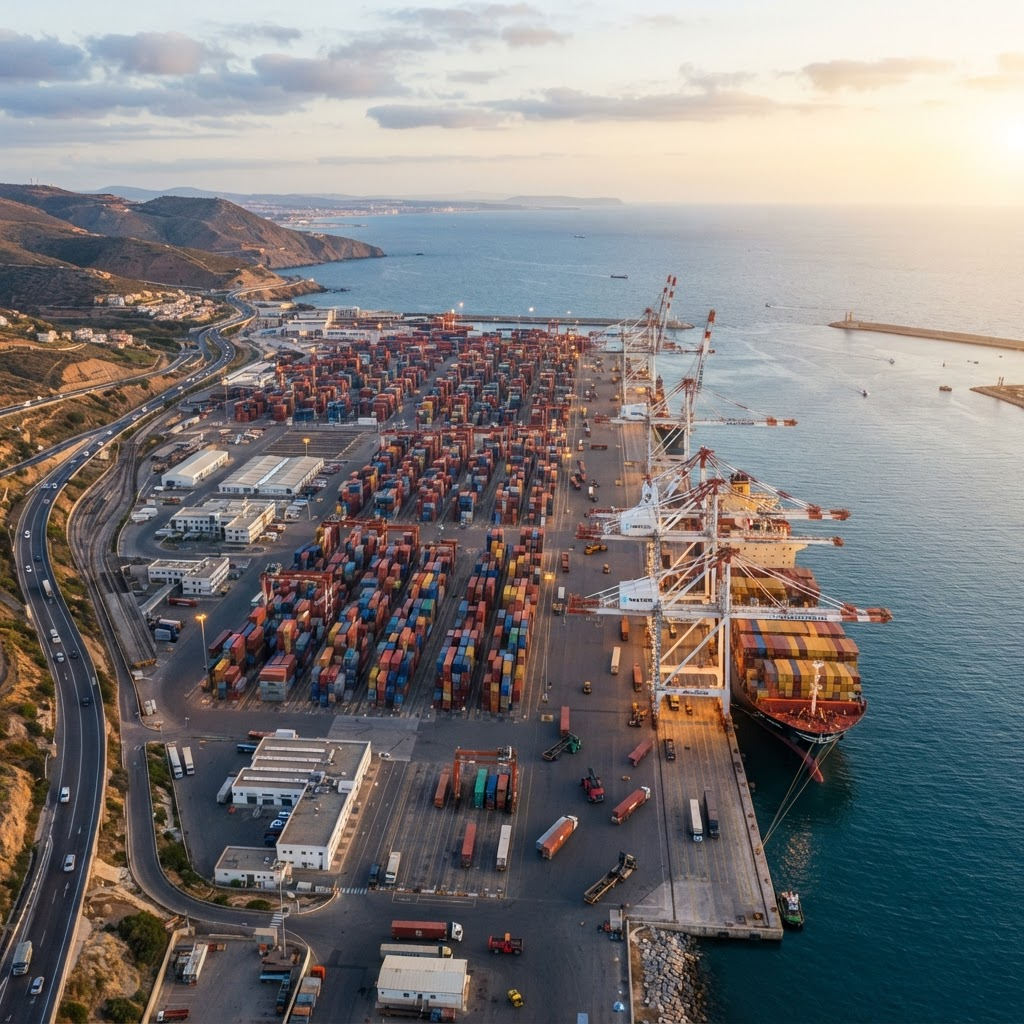
Morocco has become an important gateway connecting European, African and international supply chains. Its ports, airports, industrial zones and proximity to Europe make it an attractive location for manufacturers, importers and exporters.
At the centre of this logistics network is Tanger Med. In 2025, the port complex handled 11,106,164 TEUs, representing an increase of 8.4% compared with 2024. It also processed more than 535,000 trucks during the year, demonstrating the importance of both maritime and road freight to Morocco's international trade.
However, successfully shipping goods to or from Morocco requires more than simply selecting a carrier. Businesses must choose the right transport mode, prepare accurate documents, understand customs and regulatory requirements, anticipate freight charges and coordinate each stage of the shipment.
This guide explains the main decisions importers and exporters should consider.
1. Choosing the Right Mode of Transport
The best freight solution depends on the shipment's urgency, size, weight, destination, value and handling requirements.
Air Freight
Air freight is generally best suited to:
- Urgent and time-sensitive shipments
- High-value products
- Lightweight cargo
- Samples and replacement parts
- Products with short commercial deadlines
- Shipments requiring rapid international delivery
Air freight provides faster transit times than ocean or road transport, but its pricing is highly influenced by chargeable weight. The airline compares the shipment's actual weight with its volumetric weight and normally charges whichever is higher.
Businesses can reduce unnecessary air-freight costs by optimizing packaging, accurately measuring every package and confirming whether the shipment can be consolidated.
Ocean Freight
Ocean freight is usually the most economical option for heavy, voluminous or non-urgent international cargo.
The two principal options are:
- Full Container Load (FCL) — FCL gives one shipper the use of a complete container. It is usually suitable for large shipments, cargo requiring greater separation or businesses that want more control over container loading.
- Less than Container Load (LCL) — LCL allows several shippers to share space inside the same container. It can be more economical for smaller consignments that do not require a complete container.
Ocean-freight costs may include the base freight rate, terminal handling, documentation, security, fuel, port and destination-related charges. The total cost should therefore be reviewed rather than comparing only the initial freight rate.
Road Freight
Road freight is particularly important for trade between Morocco and Europe. Shipments can move through the Tanger Med–Algeciras corridor before continuing by road through Spain, France and other European markets.
The two main road-freight options are:
- Full Truckload (FTL) — FTL dedicates the complete truck or trailer to one shipment. It is appropriate for large volumes, sensitive cargo, urgent deliveries or shipments requiring exclusive capacity.
- Less than Truckload (LTL) — LTL combines freight from multiple shippers. It can be more economical for smaller consignments that do not require an entire vehicle.
Road freight can offer an effective balance between the speed of air freight and the economy of ocean freight, particularly for Morocco–Europe trade lanes. Hitek provides FTL and LTL road freight between Morocco and Europe, cross-border transport and specialized equipment among its road services.
Courier and Express Delivery
Courier services are generally best suited to:
- Documents
- Samples
- Small packages
- E-commerce orders
- Urgent spare parts
- Low-volume shipments requiring simple door-to-door delivery
Courier pricing may appear straightforward, but dimensional weight, remote-area fees, fuel surcharges, duties and destination charges can affect the final cost.
2. Documents Commonly Required for International Shipping
Documentation requirements vary according to the commodity, origin, destination, transport mode and applicable regulations. However, businesses should normally prepare and verify the following documents before a shipment departs.
Commercial Invoice
The commercial invoice normally identifies:
- The seller and buyer
- A clear description of the goods
- Quantities
- Unit and total values
- Currency
- Country of origin
- Agreed Incoterm
- Payment terms
Descriptions such as "parts," "equipment" or "samples" may be too vague. The goods should be described accurately enough for the parties involved in transport and customs processing to understand what is being shipped.
Packing List
The packing list should show:
- Number and type of packages
- Package dimensions
- Gross and net weight
- Marks and references
- How the goods are distributed across packages or pallets
The packing list must be consistent with the commercial invoice and the physical shipment.
Transport Document
The applicable transport document depends on the freight mode:
- Bill of lading for ocean freight
- Air waybill for air freight
- CMR consignment note for international road freight
- Courier waybill for express shipments
Certificate of Origin
A certificate of origin may be required to confirm where the goods were produced or manufactured. It can also affect the application of trade agreements and preferential tariff treatment.
Permits, Licences and Conformity Documents
Certain products may require additional authorizations, certificates or technical documents before they can be imported or exported. Requirements can apply to products such as:
- Telecommunications equipment
- Electrical and electronic products
- Food and agricultural goods
- Chemicals
- Pharmaceuticals
- Medical devices
- Batteries and dangerous goods
- Controlled or regulated products
These requirements should be checked before the shipment is booked. Discovering that a licence or certificate is missing after the cargo arrives can create delays, storage charges and additional handling costs.
3. Customs Procedures and PortNet in Morocco
Morocco uses PortNet as its national single-window platform for foreign trade. The system facilitates the electronic exchange of information between port communities, government agencies and international-trade operators. It also supports the submission and processing of documents related to import, export and transit operations.
Depending on the operation, businesses may need to coordinate with:
- The importer or exporter of record
- A freight forwarder
- A customs representative or broker
- Port or airport operators
- Shipping lines or airlines
- Government agencies
- Inspection and regulatory authorities
- Banks and insurance providers
A freight forwarder can help coordinate the transport and documentation process, but the importer or exporter remains responsible for providing correct commercial and technical information.
Before shipping, confirm:
- Whether the importer is authorized to import the product.
- Whether the goods require a licence, permit or conformity document.
- Whether the HS classification has been reviewed.
- Whether the invoice and packing list are complete.
- Whether the country-of-origin information is correct.
- Whether the chosen Incoterm clearly allocates costs and responsibilities.
- Whether duties, taxes and destination charges have been considered.
4. What Determines the Cost of Shipping to or from Morocco?
Freight pricing is influenced by several variables.
Origin and Destination
The distance, route, available carrier capacity and number of connections all affect the quotation. A direct service may cost more but reduce handling and transit time. A service involving several connections may be more economical but create additional operational risk.
Weight and Dimensions
Freight may be charged according to:
- Actual gross weight
- Volumetric weight
- Cargo volume in cubic metres
- Number of pallets
- Number and type of containers
- Loading metres
- Full-truck or shared-truck capacity
Accurate dimensions are essential. A quotation based on incorrect measurements may be revised after the carrier measures the shipment.
Type of Cargo
Rates and handling requirements can change for:
- Dangerous goods
- Perishable products
- Temperature-controlled cargo
- High-value goods
- Oversized cargo
- Fragile products
- Machinery
- Automotive components
- Cargo requiring special loading equipment
Incoterms
Incoterms determine where the seller's responsibility ends and where the buyer's responsibility begins. They can affect who pays for:
- Collection
- Export procedures
- Main transportation
- Insurance
- Destination handling
- Import procedures
- Final delivery
The lowest-looking freight quotation is not necessarily the lowest total landed cost if important origin or destination charges have been excluded.
Market Conditions and Surcharges
Freight rates may also change because of:
- Fuel prices
- Carrier capacity
- Seasonal demand
- Port congestion
- Security requirements
- Currency fluctuations
- Route disruptions
- Equipment availability
- Regulatory changes
For that reason, quotations should specify their validity period and clearly identify what is included and excluded.
5. Common Mistakes That Cause Delays and Additional Costs
- Choosing a transport mode based only on the base rate — A cheaper base rate may lead to a higher total cost when storage, handling, inventory delays or destination charges are included.
- Providing approximate dimensions — Small differences across several packages can significantly change volumetric or chargeable weight.
- Booking before checking import requirements — Cargo should not be dispatched until the required permits, declarations and conformity documents have been confirmed.
- Using vague product descriptions — Accurate descriptions reduce questions and support smoother document and customs processing.
- Ignoring destination charges — Importers should understand which charges are payable at destination and whether they are included in the freight quotation.
- Selecting the wrong Incoterm — An Incoterm should reflect the commercial agreement and the operational capabilities of both parties. It should not be selected simply because it is familiar.
- Focusing only on transit time — A fast advertised transit time does not include every stage of the shipment. Businesses should also consider collection, terminal cut-offs, customs formalities, connections and final delivery.
6. Information Needed for an Accurate Freight Quotation
To receive a useful and reliable quotation, provide:
- Pickup location
- Delivery location
- Description of the goods
- HS code, when available
- Number of packages or pallets
- Exact dimensions
- Gross weight
- Cargo value
- Preferred transport mode
- Required pickup date
- Incoterm
- Dangerous-goods classification, when applicable
- Temperature or handling requirements
- Insurance requirements
- Import or export permits already available
Hitek's online quotation form currently collects client details, service type, transport mode, Incoterm, goods description, weight, dimensions, quantity, pickup and delivery locations and optional additional services.
7. How Hitek Logistic Morocco Supports International Shipments
Hitek Logistic Morocco is an international freight forwarder and third-party logistics provider based in Tangier, Morocco.
The company coordinates:
- Air freight
- Ocean freight, including FCL and LCL
- Road freight, including FTL and LTL
- Courier services
- Warehousing
- Cross-docking
- Project cargo
- White-glove logistics
- Supply-chain and strategic logistics solutions
Through its location in Tangier and access to international partners, Hitek supports importers, exporters and manufacturers moving cargo between Morocco, Europe, Africa, North America and international markets. The company's website provides dedicated air, ocean and road-freight services, alongside warehousing and specialized-project solutions.
Frequently Asked Questions
What is the best way to ship goods to Morocco?
The best transport mode depends on the shipment. Air freight is normally selected for urgent or valuable cargo, ocean freight for larger international shipments, road freight for Morocco–Europe movements and courier services for small parcels and documents.
Is FCL or LCL better for ocean freight?
FCL is generally suitable when cargo requires a full container, greater control or dedicated space. LCL may be more economical when the shipment is too small to justify an entire container. The most economical option depends on volume, weight, routing, handling and destination charges.
What documents do I need to import goods into Morocco?
The exact requirements depend on the product and transaction. Common documents include a commercial invoice, packing list, transport document, certificate of origin and any product-specific licences or conformity certificates. The requirements should be verified before booking transportation.
Does Hitek provide customs-clearance assistance?
Hitek supports customers with international-shipping documentation and customs-clearance coordination. The exact responsibilities and required parties depend on the shipment, commodity and applicable regulations.
How can I request a freight quotation?
Prepare your pickup and delivery locations, cargo description, number of packages, dimensions, weight, preferred transport mode, Incoterm and any special handling requirements. You can then submit these details through Hitek Logistic Morocco's online quotation form.
Conclusion
Shipping to or from Morocco can be efficient and predictable when the transport mode, documentation, regulatory requirements and total costs are reviewed before departure.
The most effective logistics solution is not always the fastest or the cheapest quoted option. It is the option that meets the shipment's deadline, budget, compliance requirements and operational risks.
Hitek Logistic Morocco helps importers, exporters, manufacturers and international partners coordinate air, ocean, road and multimodal freight solutions through Morocco and international markets.
Planning an upcoming shipment? Request a customized freight quotation and provide your cargo details, origin, destination and required delivery schedule.