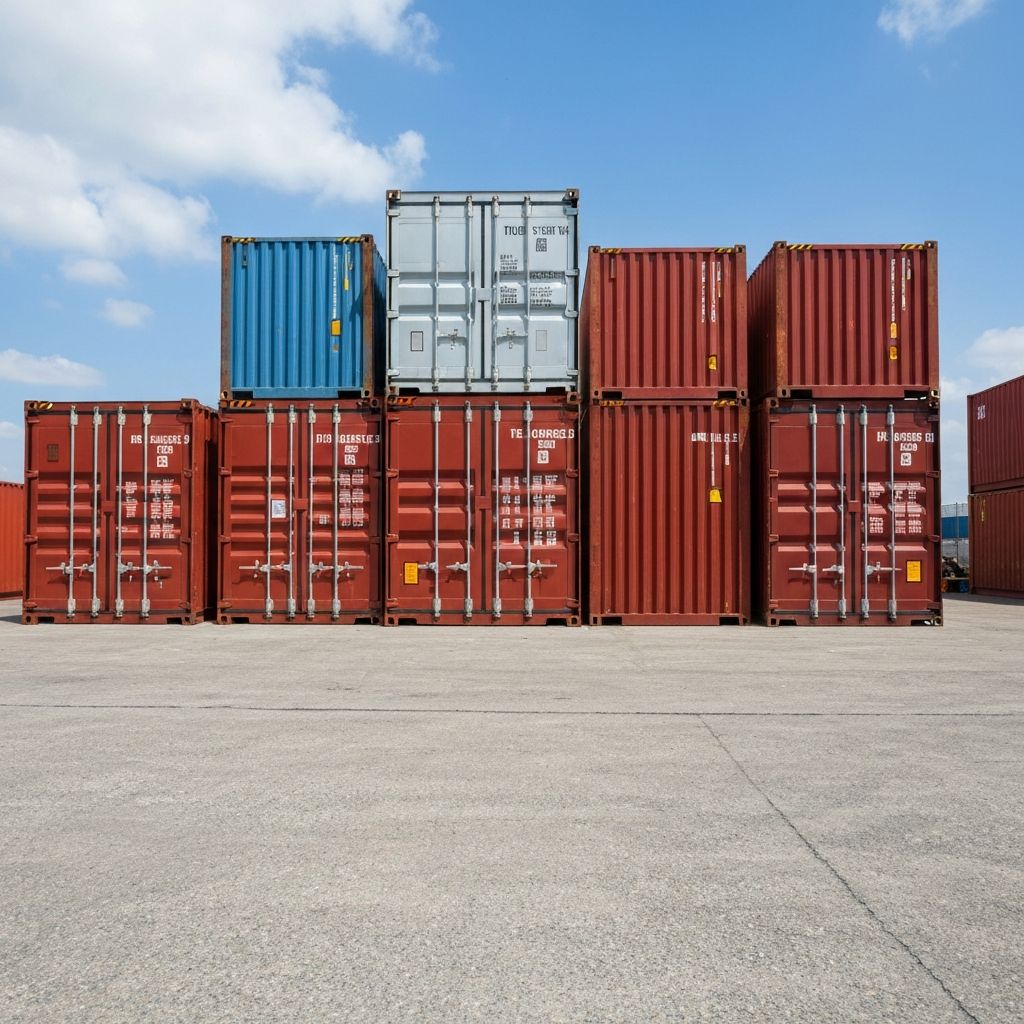
The intermodal shipping container is one of the most consequential inventions of the twentieth century: a simple steel box that quietly rebuilt the architecture of global trade. Here is where it came from, how the main types got their names, and what sets one type apart from another.
1. A Short History of the Shipping Container
The idea of a reusable cargo box is older than most people think. In 1766, English engineer James Brindley built a coal boat carrying ten wooden containers, and by the 1830s early railways were already transferring timber boxes between wagons and carts. Europe formalized the idea between 1933 and 1935, when the Bureau International des Containers in Paris set the first international container standards.
The modern steel container took shape through the US military. The Army's 1948 Transporter evolved by 1952 into the CONEX box—short for “Container Express”—with more than 100,000 units in service by 1965. Around the same time, engineer Keith Tantlinger designed the twistlock, the rotating fitting that locks stacked containers together, and released the patent royalty-free, allowing it to become the global standard almost overnight.
The breakthrough came on 26 April 1956, when trucking entrepreneur Malcolm McLean sailed the converted tanker Ideal-X from Newark to Houston with 58 containers aboard. The voyage is generally credited as the birth of modern containerized shipping. Between 1968 and 1970, the ISO standardized container dimensions and fittings through ISO 668, and the 1972 International Convention for Safe Containers (CSC) added mandatory safety testing. About 90 percent of the world's container fleet still follows these ISO standards, which underpin a large share of global seaborne trade.
2. How Container Types Got Their Names
- Reefer: Short for “refrigerator,” carried over from refrigerated rail cars and trucks.
- CONEX: The US Army's “Container Express” system; the term is still used loosely for steel storage boxes.
- Sea Can / C-Can: North American slang reflecting the box's maritime, can-like shape.
- High Cube: A container built one foot taller—9 ft 6 in—for extra volume.
- Flat Rack: A flat steel platform that “racks” heavy or oversized loads for crane lifting.
- Open Top: A box with a removable tarpaulin roof instead of a solid one, allowing it to be loaded from above.
- Tank Container or “tanktainer”: A tank cradled in a standard ISO steel frame.
- TEU / FEU: “Twenty-foot Equivalent Unit” and “Forty-foot Equivalent Unit” are capacity units, not container types. One 40-ft box equals two TEU.
Every container also carries a formal ISO 6346 identity: a three-letter owner code, a category letter—almost always U for a freight container—a six-digit serial number, and a check digit. A size and type code such as 20GP or 40HC is also stencilled on the door, telling handlers its length, height and function at a glance.
3. The Main Container Types
General-purpose, or dry van, boxes make up about 90 percent of the fleet. They have corrugated steel walls, a plywood floor and a solid roof, and carry palletized and boxed cargo in 20-ft and 40-ft lengths. High cube containers are simply one foot taller and suit light but bulky goods.
Reefers add an electric refrigeration unit for perishables and pharmaceuticals, operating from approximately -30°C to +30°C. Open top containers replace the solid roof with a removable tarpaulin so cranes can load oversized items vertically, while flat racks remove the roof and side walls entirely to carry vehicles, machinery and out-of-gauge cargo.
Tank containers carry bulk liquids, gases and powders in a cylindrical tank mounted inside a standard frame. Ventilated containers use louvred openings to limit condensation on cargo that “breathes,” such as coffee or onions. Bulk containers load loose grain or minerals through roof hatches, while half-height containers carry dense loads such as coal or scrap metal.
A few regional variants also exist: wider 48-ft and 53-ft containers in North America, pallet-wide boxes in Europe, and shorter 12-ft units in Japan. These are largely domestic and are not part of standard deep-sea ocean shipping.
| Code | Type | Typical use |
|---|---|---|
| 20GP / 40GP | General Purpose (“dry van”) | General cargo, boxed and palletized goods |
| 40HC / 45HC | High Cube | Bulky, low-density cargo needing extra headroom |
| 20RF / 40RH | Reefer (Refrigerated) | Perishable food, pharmaceuticals and flowers |
| 20OT / 40OT | Open Top | Machinery, glass and timber loaded from above by crane |
| 20FR / 40FR | Flat Rack | Vehicles, pipes, steel coils and out-of-gauge cargo |
| 20TK | Tank Container | Bulk liquids, gases and powders |
| 20VH | Ventilated Container | Coffee, cocoa, onions and other cargo needing airflow |
| 20BU / 20UT | Bulk Container (Bulktainer) | Grain, minerals and powders loaded loose |
4. Conclusion
From an eighteenth-century coal boat to Malcolm McLean's Ideal-X and today's global fleet of reefers, tank containers and flat racks, the shipping container's story is one of steady, cumulative standardization: many engineers solving the same problem until it became a single global system.
To learn how some of these containers carry regulated cargo safely, read our companion article on dangerous goods classification and transport.