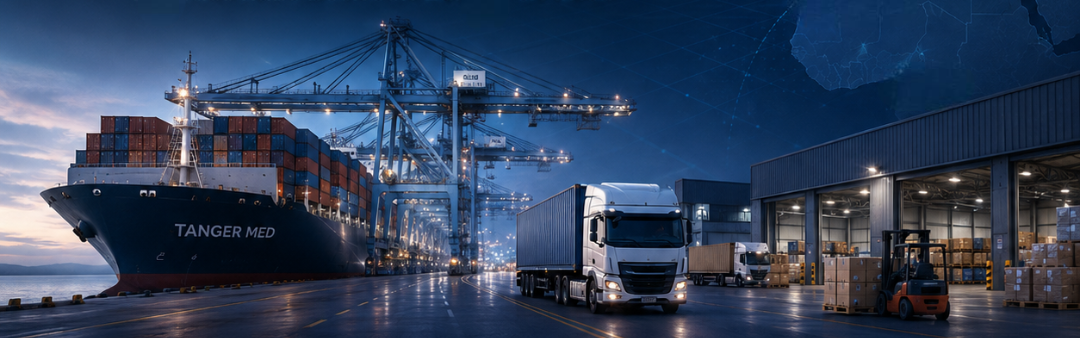
Tanger Med: A Strategic Logistics Gateway Between Europe, Africa and Global Markets
For companies importing into Morocco, exporting to Europe, managing automotive supply chains or developing distribution operations across Africa, Tanger Med has become one of the most important logistics locations in the region.
Located on the Strait of Gibraltar, only a short maritime distance from southern Spain, Tanger Med combines a major container port, Ro-Ro connections, industrial zones, logistics facilities, customs infrastructure, and road and rail connectivity in a single ecosystem.
In 2025, the Tanger Med Port Complex handled 11,106,164 TEUs, an increase of 8.4% compared with 2024. Truck traffic reached 535,203 units, while total cargo handled across port activities reached approximately 161 million tonnes.
Those figures help explain why international manufacturers, distributors, automotive suppliers, freight forwarders, and third-party logistics providers increasingly use Tangier—and particularly Tanger Med—as a gateway for Morocco, Europe, the Mediterranean, and Africa.
But the value of Tanger Med is not simply the size of the port. Its real logistics advantage comes from connecting transport, warehousing, customs, consolidation, and distribution within the same supply-chain ecosystem.
What Is Tanger Med?
Tanger Med is an integrated port, logistics, and industrial complex in northern Morocco. The port complex includes container terminals, Ro-Ro and passenger facilities, vehicle terminals, general cargo operations, rail infrastructure, and other specialized activities.
Its location near the entrance to the Mediterranean gives shipping lines access to major East-West and North-South maritime routes. Tanger Med reports connections with more than 180 ports across around 70 countries, providing access to Europe, Africa, Asia, and the Americas.
The surrounding logistics ecosystem makes it possible to combine:
- Ocean freight
- International road freight and Ro-Ro transport
- Warehousing and inventory management
- Cross-docking
- Consolidation and deconsolidation
- Order preparation, packaging, and labelling
- Customs coordination
- Moroccan, European, and regional African distribution
This is what transforms Tanger Med from a port into a supply-chain platform.
Why Tanger Med Matters for European–Moroccan Trade
Morocco's manufacturing and export sectors are closely connected to European markets. Automotive components, textiles, food products, industrial goods, and other cargo move continuously between Moroccan factories and customers or suppliers in Spain, France, Germany, Portugal, Italy, and other European markets.
For many of these shipments, road freight does not remain entirely on the road. A truck leaving a Moroccan factory can travel to Tanger Med, cross the Strait of Gibraltar by Ro-Ro ferry, and continue through the European road network. The same principle works in reverse for imports from Europe into Morocco.
This model is especially valuable for automotive manufacturing, just-in-time production, industrial spare parts, electronics, textiles, food products, retail replenishment, and production-critical shipments.
Tanger Med and Morocco's Automotive Supply Chain
Automotive logistics is one of the clearest examples of Tanger Med's strategic importance. The industrial platform hosts international Tier 1, Tier 2, and Tier 3 suppliers serving Moroccan facilities and European assembly plants.
During 2025, Tanger Med handled 526,862 vehicles, including more than 327,000 vehicles exported from Renault facilities and more than 126,000 from Stellantis in Kenitra.
Automotive supply chains often require fixed collection schedules, precise delivery windows, supplier inventory management, cross-docking, milk-run operations, FTL and LTL transport, emergency freight, real-time visibility, customs coordination, and backup transport solutions. A strong 3PL operation therefore becomes part of the manufacturer's production strategy rather than simply a transport supplier.
What Is the Tanger Med Logistics Zone?
Adjacent to the port complex is the Tanger Med Logistics Zone, commonly known as MEDHUB. It was developed for companies wanting to establish regional storage, consolidation, and distribution operations close to the port.
The zone supports warehousing, order preparation, packaging, labelling, quality inspection, consolidation, distribution, procurement logistics, and advanced supplier warehousing. Its proximity to Tanger Med is particularly attractive for goods arriving by container or truck that require storage, processing, or redistribution before reaching their final market.
Hitek Logistic Morocco is officially listed among the logistics operators present in the Tanger Med Logistics Zone.
What Is 3PL Warehousing?
3PL means Third-Party Logistics. Instead of operating its own warehouse, personnel, inventory systems, and transport network, a company can outsource part or all of those activities to a specialized provider.
A typical flow can be represented as:
Supplier → International Transport → Tanger Med → Warehouse → Inventory → Order Preparation → Distribution → Customer
The 3PL becomes the operational link between each stage.
Typical 3PL Services in Morocco
1. Warehousing
Goods can be stored for short, medium, or long periods according to pallet positions, floor space, SKU, product family, batch, customer, project, or stock-rotation requirements. A professional operation must show what is stored, where it is stored, how much is available, and when it moved.
2. Inventory Management
Inventory accuracy is critical when the warehouse supplies a factory, distributor, or customer network. A warehouse management process should track receiving, put-away, storage, picking, preparation, and dispatch.
For manufacturers, a missing pallet may represent more than missing inventory: it may create a production stoppage.
3. Cross-Docking
Cross-docking allows incoming goods to spend little or no time in long-term storage. Cargo is unloaded, sorted or consolidated, and quickly transferred to outbound transport.
It is particularly useful for automotive components, retail distribution, high-turnover products, time-sensitive goods, and multi-supplier operations.
4. Consolidation and Deconsolidation
Several smaller European shipments can be grouped into a larger LTL movement to improve vehicle utilization. In the opposite direction, a container arriving at Tanger Med can be unloaded and separated by consignee before orders are prepared for Tangier, Kenitra, Casablanca, Rabat, or other destinations.
5. Order Fulfilment and Value-Added Services
A 3PL warehouse can pick, prepare, label, and dispatch individual orders instead of shipping complete pallets. Services can also include relabelling, repacking, kitting, bundling, quality control, palletization, sorting, and product inspection.
6. Advanced Supplier Warehousing
An Advanced Supplier Warehouse positions inventory close to a customer's manufacturing facility. Suppliers maintain nearby stock, and the warehouse releases components according to production requirements.
This creates a buffer between international transportation and factory consumption, improving continuity while reducing inventory pressure inside the plant.
Free-Zone Warehousing at Tanger Med
The Tanger Med logistics environment can support international flows that do not immediately enter Morocco's domestic market. Goods imported from Asia, for example, may later be distributed to Morocco, Spain, France, West Africa, or other Mediterranean markets.
Depending on the applicable customs regime and operation, goods within the free-zone environment can be held for later re-export or released into the Moroccan market when required. This makes the zone useful for companies building regional distribution hubs rather than traditional domestic warehouses.
Hitek's warehousing operation is located within the Tanger Med Zone Franche Logistique / MEDHUB area and supports storage, inventory management, and onward distribution. Customs treatment depends on the goods, transaction, destination, and applicable Moroccan regulations, so every operation should be validated before shipment.
For additional guidance, read our Customs Clearance in Morocco 2026 guide.
Tanger Med as a Regional Distribution Hub
A regional hub can connect international suppliers with Morocco, Europe, and Africa from one logistics platform. This can provide:
- Reduced transport fragmentation: Larger international movements can be separated near their final markets.
- Inventory pooling: Businesses can centralize part of their stock rather than maintaining independent inventory in several countries.
- Faster regional response: Stock near international transport links can react more quickly to customer demand.
- Supply-chain resilience: A regional warehouse can provide safety stock during international transport disruptions.
MEDHUB describes its logistics zone as supporting distribution toward Europe, the Mediterranean, and Africa, with access to a market of more than one billion consumers.
Integrated Freight and Warehousing Models
Ocean Freight + Warehouse + Road Distribution
Cargo arrives in Morocco as an FCL container or LCL shipment, is unloaded and stored, then dispatched by road to customers or manufacturing facilities. One freight forwarder or 3PL can coordinate the complete operation and reduce handovers.
For more detail on FCL, LCL, container types, and rates, see our Ocean Freight Pricing guide.
Road Freight + Tanger Med Warehousing
A European automotive supplier can move cargo by truck through Europe to Spain, cross by ferry to Tanger Med, and store components close to the Moroccan production location. Smaller quantities are then released according to actual demand.
This combines international road freight + buffer stock + local distribution and can be more flexible than treating every shipment as a standalone transport operation.
When Should a Company Use Warehousing in Tanger Med?
Tanger Med warehousing can be useful when:
- Customers require frequent deliveries
- Suppliers are overseas and local safety stock is needed
- A factory operates with limited on-site inventory
- Containers must be deconsolidated into smaller deliveries
- One central warehouse must serve several Moroccan customers
- Stock supports both Morocco and international markets
- Seasonal peaks require flexible capacity
- A business is entering Morocco without building its own warehouse
What to Look for in a 3PL Provider in Morocco
Location
Assess proximity to Tanger Med, your factory, customers, major highways, and customs facilities. A lower storage price can be offset by higher transport costs.
Operational Capability
Confirm whether the provider supports cross-docking, container unloading, palletization, picking, packing, labelling, kitting, quality inspection, inventory reporting, consolidation, and distribution.
Inventory Visibility
A professional 3PL should provide accurate information about what arrived, when it arrived, where it is stored, what was dispatched, and what remains available.
Transportation Capability
A warehouse becomes more useful when the same partner can organize FTL, LTL, domestic Moroccan transport, Morocco–Europe transport, ocean freight, air freight, courier, and emergency shipments.
Customs Knowledge
Documentation, customs status, and cargo movements affect international warehousing. Incorrect assumptions can lead to delays, storage charges, or unexpected duties.
Common Warehousing Mistakes
- Choosing a warehouse only by storage price
- Failing to define inbound and outbound handling charges
- Starting with inaccurate SKU, quantity, or documentation data
- Ignoring the customs status of domestic and re-export goods
- Maintaining too little safety stock for production-critical components
- Maintaining excessive stock that consumes space and working capital
The objective is not maximum stock. It is the right stock at the right location.
How Hitek Logistic Morocco Supports Tanger Med Logistics
Hitek Logistic Morocco operates as a freight forwarder and third-party logistics provider in Tangier and provides warehousing through the Tanger Med logistics ecosystem. Hitek is listed by MEDHUB among logistics operators established within the Tanger Med Logistics Zone.
Its services can integrate:
- Warehousing and inventory management
- 3PL operations and order processing
- Distribution and cross-docking
- FTL and LTL road freight
- Ocean freight, air freight, and courier solutions
- Customs-clearance support
- Special projects and international shipment coordination
Hitek's warehouse service connects storage and onward distribution with air, ocean, and road transport through one logistics partner. The goal is to reduce disconnected handovers between port, warehouse, carrier, and final customer.
Example: A European Automotive Supplier Using Tanger Med
A practical supply chain could work as follows:
- Components are consolidated in Europe.
- Goods move by road toward southern Spain.
- The trailer crosses to Tanger Med by Ro-Ro.
- Inventory enters a Tanger Med-area warehouse.
- Stock is registered and monitored.
- The factory transmits scheduled requirements.
- The warehouse prepares the requested quantity.
- A local truck delivers the components to production.
The warehouse acts as a buffer between international transport and production. If international transport is delayed, production may continue using inventory already positioned in Morocco.
Tanger Med in 2026: More Than a Port
During 2025, Tanger Med processed more than 11.1 million TEUs, more than 535,000 trucks, and approximately 161 million tonnes of cargo. It also received 1,319 vessels longer than 290 metres, demonstrating its role within major international shipping networks.
Its importance comes from combining:
Port infrastructure + International connectivity + Industrial production + Free-zone logistics + Warehousing + Road transport + Customs + Distribution
The real opportunity is using this complete ecosystem to build a more efficient and resilient supply chain.
Conclusion
Tanger Med has become one of Morocco's most important logistics gateways and an increasingly strategic location for supply chains connecting Europe, Morocco, the Mediterranean, and Africa.
Warehousing and 3PL operations around Tanger Med can support regional inventory, cross-docking, consolidation, deconsolidation, automotive supply, advanced supplier warehousing, order fulfilment, domestic and European distribution, and import or re-export operations.
At Hitek Logistic Morocco, our team supports international and Moroccan companies with freight forwarding, Tanger Med warehousing, 3PL operations, road freight, ocean freight, air freight, distribution, and customs-clearance coordination.
Planning a logistics or warehousing operation in Morocco? Contact Hitek Logistic Morocco to discuss the most efficient transport, storage, and distribution structure for your supply chain.