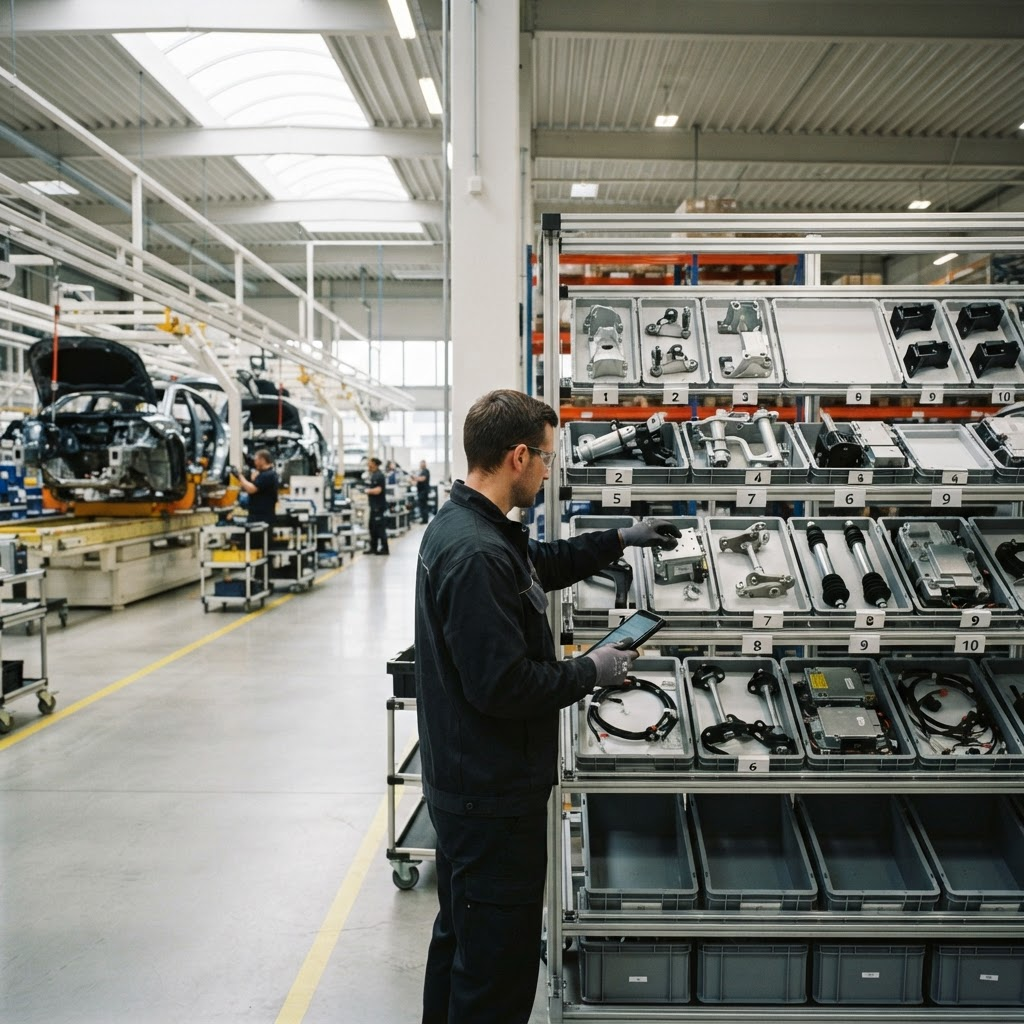
Introduction — Why Timing Defines Automotive Logistics
In automotive manufacturing, a component that arrives too late can stop a production line, and a component that arrives too early can occupy valuable space on the factory floor. This is why automotive supply chains in Morocco are built around precise delivery models such as JIT and JIS.
This article explains how Just-in-Time and Just-in-Sequence logistics work, how flows differ across Tier 1, Tier 2 and Tier 3 suppliers, and how to manage production-critical shipments when something goes wrong.
This article is part 2 of a four-part Hitek Logistic Morocco series on automotive logistics in Morocco in 2026. The other parts cover Morocco's Automotive Hub & Tanger Med, Morocco–Europe Automotive Freight and Automotive Warehousing & 3PL.
What Is JIT Automotive Logistics?
JIT stands for Just-in-Time.
In automotive manufacturing, the principle is simple: components should arrive close to the moment they are required for production rather than remaining in large quantities inside the factory.
Instead of maintaining several weeks of inventory on the production site, manufacturers can rely on scheduled deliveries and carefully managed supply-chain buffers.
For example:
Supplier → International Transport → Tanger Med → Buffer Warehouse → Scheduled Release → Factory
The warehouse can hold inventory near the production facility while the factory receives only the quantity required by its production schedule.
This can help companies:
- Reduce on-site inventory
- Improve warehouse-space utilization
- Coordinate supplier deliveries
- Reduce unnecessary handling
- Increase inventory visibility
- Create a buffer against international transport variability
However, JIT also increases the importance of logistics reliability.
If a production line depends on a component arriving on Tuesday morning, a missed collection or delayed international shipment can become an operational problem.
That is why JIT logistics requires more than transportation. It requires planning, visibility, inventory control and contingency management.
JIS Logistics: Just-in-Sequence Automotive Deliveries
JIS means Just-in-Sequence.
With JIS, components are delivered not only at the required time but also in the sequence in which they will be used during production.
For example, if vehicles are being assembled with different interior configurations, components may need to arrive in the exact sequence corresponding to the production schedule.
This creates additional logistics requirements:
- Accurate production information
- Precise picking
- Sequence management
- Correct labelling
- Real-time inventory visibility
- Reliable local transportation
- Strong communication between supplier, warehouse and factory
For JIS operations, a warehouse can become more than a storage location. It can become an operational extension of the automotive production process.
Tier 1, Tier 2 and Tier 3 Automotive Suppliers
Automotive logistics also needs to account for the different levels of the supplier ecosystem.
Tier 1 suppliers generally deliver systems or major components directly to vehicle manufacturers. Their logistics requirements can include scheduled deliveries, dedicated transport, advanced supplier warehousing, sequencing and strict delivery windows.
Tier 2 suppliers provide components to Tier 1 suppliers. Their logistics flows may involve smaller shipments, consolidation, LTL transportation, scheduled collections and inventory management.
Tier 3 suppliers typically provide raw materials, basic components or processed materials further upstream in the supply chain. These shipments may require consolidation and efficient international freight management to control logistics costs.
A 3PL provider can coordinate different transport and warehousing solutions across these supply-chain levels.
Managing Production-Critical Automotive Shipments
Not every shipment has the same level of urgency.
A standard replenishment shipment can often be planned several days in advance. A production-critical shipment is different.
When a component is urgently required, logistics teams may need to coordinate immediate supplier collection, priority transport, customs documentation, Tanger Med operations, alternative routing, emergency local delivery and continuous shipment monitoring.
A good automotive logistics strategy should therefore include contingency options before an emergency occurs.
These can include:
- Safety stock
- Alternative carriers
- Backup transport capacity
- Emergency road freight
- Local buffer inventory
- Alternative delivery routes
The goal is not to eliminate every possible disruption. The goal is to ensure that the supply chain can respond when disruption occurs.
Conclusion
JIT and JIS models allow automotive manufacturers in Morocco to reduce on-site inventory and synchronize supplier deliveries with production. They also make every delay more visible and more costly.
A reliable JIT or JIS operation combines accurate production information, buffer inventory near the plant, dependable local transport and contingency options for production-critical shipments.
Explore the rest of the series: Morocco's Automotive Hub & Tanger Med, Morocco–Europe Automotive Freight and Automotive Warehousing & 3PL. Hitek supports these flows through road freight, warehousing and special project services.
Contact Hitek Logistic Morocco to discuss your automotive supply-chain requirements.