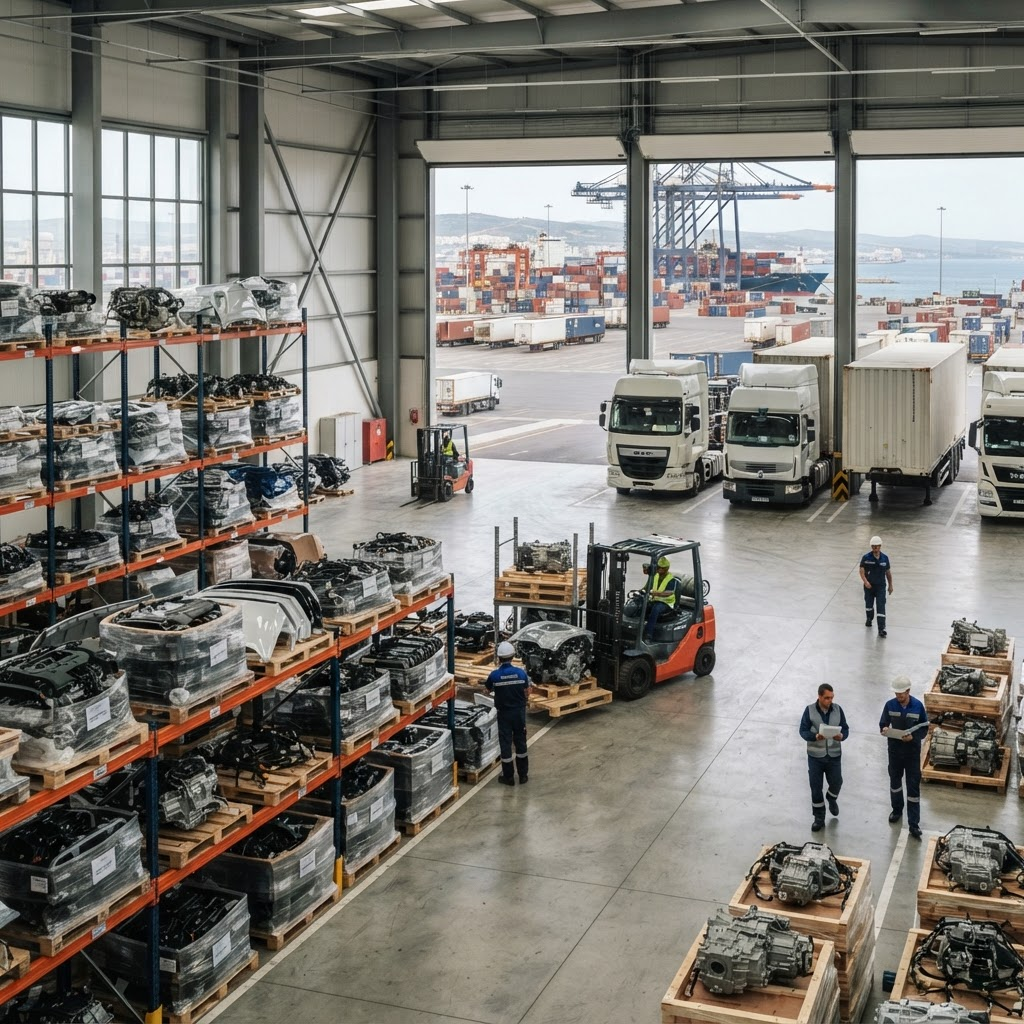
Introduction — Warehousing as a Buffer for Automotive Production
International transport can be affected by weather, port congestion, documentation issues or capacity constraints. For automotive plants that depend on steady component supply, warehousing near the production site creates an important buffer.
This article explains how automotive warehousing, cross-docking, advanced supplier warehousing and inventory visibility can make supply chains in Morocco more resilient, and how Hitek Logistic Morocco supports these operations.
This article is part 4 of a four-part Hitek Logistic Morocco series on automotive logistics in Morocco in 2026. The other parts cover Morocco's Automotive Hub & Tanger Med, JIT & JIS Automotive Logistics and Morocco–Europe Automotive Freight.
Automotive Warehousing Near Tanger Med
Warehousing can play an important role in automotive supply chains.
A warehouse near Tanger Med can act as a buffer between international suppliers and Moroccan production.
Instead of requiring every European shipment to arrive at the factory exactly when production needs the components, inventory can be positioned in Morocco and released according to demand.
A typical model is:
European Supplier → Morocco–Europe Freight → Tanger Med → Automotive Warehouse → Scheduled Factory Deliveries
Depending on the operation, automotive warehouses may provide:
- Pallet storage
- Inventory management
- Picking
- Labelling
- Kitting
- Quality checks
- Repacking
- Consolidation
- Deconsolidation
- Cross-docking
- Scheduled local deliveries
Cross-Docking for Automotive Logistics
Cross-docking is useful when cargo does not need long-term storage.
Incoming goods are unloaded, sorted or consolidated and transferred quickly to outbound transportation.
For example:
European Supplier A + Supplier B + Supplier C → Tanger Med Logistics Facility → Moroccan Factory
Instead of storing every shipment for an extended period, the logistics operation can consolidate the required components and prepare them for onward delivery.
Cross-docking can be useful for high-frequency automotive flows, scheduled supplier deliveries and components with short replenishment cycles.
Advanced Supplier Warehousing
An advanced supplier warehouse positions inventory close to the customer's production site.
This model can be useful when the supplier is located in Europe but the customer operates a manufacturing plant in Morocco.
Instead of keeping all inventory at the European supplier's facility, part of the stock can be positioned near the Moroccan factory.
The supply chain then becomes:
European Supplier → International Transport → Morocco → Advanced Supplier Warehouse → Factory
The warehouse provides a buffer between international transport and production.
If a European truck or ferry movement experiences an unexpected delay, inventory already positioned in Morocco can provide additional protection against production disruption.
Automotive Logistics and Inventory Visibility
Modern automotive supply chains depend heavily on visibility.
Knowing that a truck has departed is useful. Knowing whether the shipment has been collected, reached Tanger Med, completed the relevant formalities, crossed to Europe, left the port, reached the delivery region and arrived at the factory provides much greater operational value.
Warehouse visibility is equally important.
Companies need reliable information about what inventory is available, what has arrived, what has been dispatched, where the stock is located, what quantity is available and what quantity is allocated to production.
This information helps logistics teams react before a shortage becomes a production problem.
Building a Resilient Automotive Supply Chain in Morocco
Automotive supply chains are exposed to several potential sources of disruption, including international transport delays, port congestion, ferry disruptions, customs delays, supplier delays, unexpected demand changes, production schedule changes and equipment shortages.
A resilient logistics model can combine several layers:
International Freight + Tanger Med + Buffer Stock + Warehousing + Local Distribution + Visibility + Contingency Transport
The purpose is not simply to keep more inventory. The objective is to place the right inventory at the right location while maintaining alternative solutions when the normal flow is disrupted.
How Hitek Logistic Morocco Supports Automotive Logistics
Hitek Logistic Morocco supports companies operating international supply chains from its logistics base in Tangier and through the Tanger Med logistics ecosystem.
For automotive companies, logistics requirements can involve several services at the same time.
Hitek can coordinate solutions including:
- Automotive warehousing
- 3PL operations
- Inventory management
- Cross-docking
- FTL road freight
- LTL and groupage
- Morocco–Europe transport
- Ocean freight
- Air freight
- Customs-clearance coordination
- Local distribution
- Emergency shipments
- Special logistics projects
This integrated approach allows companies to coordinate transport and warehousing rather than managing every stage independently.
For a European automotive supplier, for example, Hitek can support a logistics flow from supplier collection in Europe through the Morocco–Europe corridor, Tanger Med, local warehousing and final delivery to a Moroccan production site.
Example: European Automotive Supplier to a Moroccan Factory
Consider a European supplier delivering components to an automotive plant in Morocco.
Step 1 — Supplier Collection. The components are collected from the European supplier according to the agreed schedule.
Step 2 — International Transport. The cargo travels by road toward the Morocco–Europe corridor.
Step 3 — Tanger Med. The truck reaches Tanger Med and completes the required port and customs processes.
Step 4 — Warehousing. Instead of delivering directly to the factory, the components can enter a nearby warehouse.
Step 5 — Inventory Management. The warehouse records the incoming stock and makes the inventory available for scheduled releases.
Step 6 — Factory Requirement. The production team communicates its requirements according to the manufacturing schedule.
Step 7 — Local Delivery. The required components are picked and delivered to the factory at the agreed time.
This creates a buffer between international transportation and production. The same principle can be adapted for different volumes, frequencies and delivery requirements.
Conclusion
Automotive logistics in Morocco in 2026 is built around more than moving components from one location to another.
It connects European suppliers, Moroccan manufacturers, automotive Tier 1, Tier 2 and Tier 3 suppliers, Tanger Med, logistics facilities and European markets into one integrated supply chain.
JIT and JIS models increase the importance of timing. Tanger Med provides a strategic connection between Morocco and international markets. Warehousing and cross-docking can create valuable buffers between international transport and production. And Morocco–Europe road freight provides a critical connection between automotive suppliers and manufacturing sites on both sides of the Strait of Gibraltar.
For companies operating in this environment, choosing the right logistics structure can help improve visibility, flexibility and supply-chain continuity.
Hitek Logistic Morocco supports automotive and industrial companies with freight forwarding, warehousing, 3PL, road freight, ocean freight, air freight, distribution and logistics coordination in Morocco and internationally.
Revisit the full series: Morocco's Automotive Hub & Tanger Med, JIT & JIS Automotive Logistics and Morocco–Europe Automotive Freight. Explore Hitek's warehousing, road freight and special project services.
Contact Hitek Logistic Morocco to discuss your automotive supply-chain requirements.